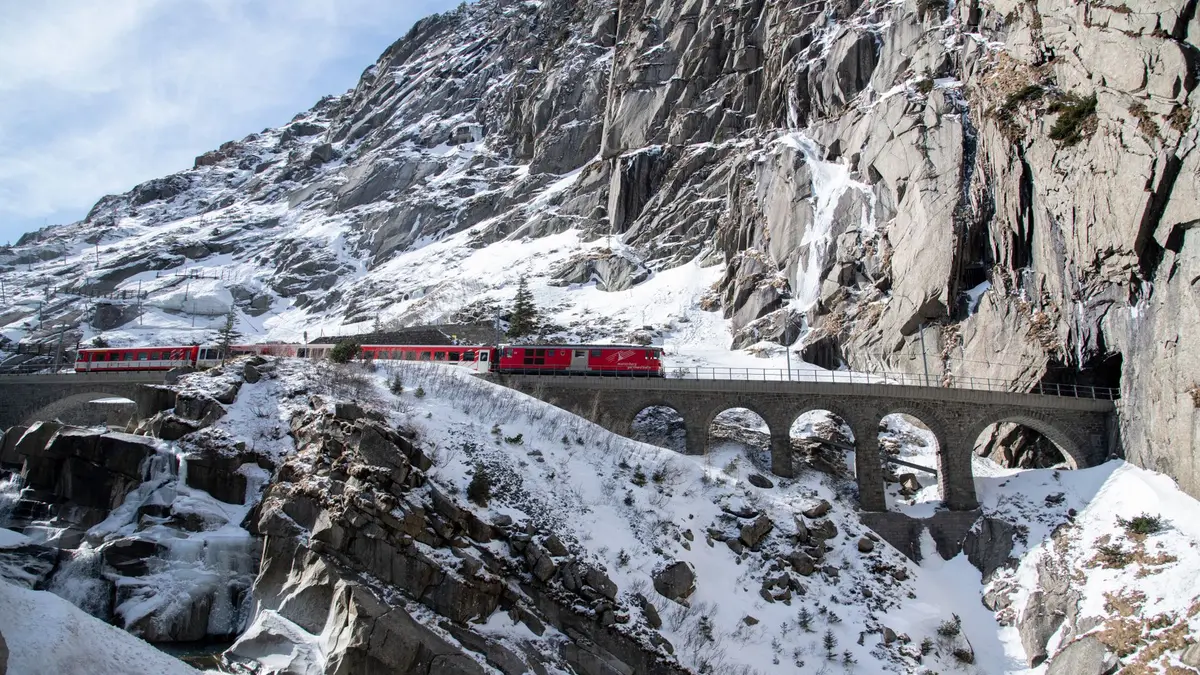
Why Switzerland by Train
Switzerland has the densest, most punctual, and most scenically engineered railway network in the world. The Swiss Federal Railways (SBB) runs over 11,000 trains per day across a country smaller than West Virginia, and 92% of them arrive within one minute of schedule. The trains are clean, quiet, and comfortable. The stations are efficient. The connections work. But none of that is why you take the train in Switzerland.
You take the train because the Swiss built their railways through the Alps, not around them. The engineering is staggering: spiral tunnels bored through granite, viaducts spanning gorges at 65 metres high, rack railways climbing gradients that would stall a car. The result is a transport system that doubles as a sightseeing experience. Every window seat is a front-row view of glaciers, waterfalls, alpine meadows, and medieval villages that no road can reach.
Driving in Switzerland is expensive (motorway vignettes, petrol at CHF 1.80/litre, parking at CHF 30+/day in cities) and stressful in the mountains. Flying is pointless for domestic travel in a country 220km wide. The train is how Switzerland moves, and it's how you should too.
Five routes stand above the rest. Each one is a curated journey through a different face of the Swiss Alps, and together they cover the country's most spectacular scenery from the Mediterranean-tinged south to the glacial north. Here's how to ride all five.

1. Glacier Express — Zermatt to St. Moritz
Billed as "the slowest express train in the world," the Glacier Express connects two of Switzerland's most iconic mountain resorts across the heart of the Alps.
The Glacier Express is not fast, and that's the point. Over eight hours, it traverses 291 bridges, passes through 91 tunnels, and climbs to the Oberalp Pass at 2,033 metres above sea level — the highest point on the route. The train moves at an unhurried pace specifically designed to let passengers absorb the scenery, and the scenery is relentless.
The journey divides into three distinct phases. The first stretch out of Zermatt rises through the Matter Valley with views of the Matterhorn (weather permitting — sit on the right side heading east for the best angle). The middle section crosses the Oberalp Pass, where the landscape opens into a vast plateau of snowfields even in July. The final descent into St. Moritz follows the Rhine gorge, sometimes called the "Swiss Grand Canyon," where the river has carved 400-metre-deep walls through the limestone.
Booking the Glacier Express
Seat reservations are mandatory and cost CHF 49 in summer (CHF 39 in winter) on top of the ticket price. The standard 2nd class ticket runs about CHF 158, but Swiss Travel Pass holders ride free and only pay the reservation supplement. Book 3-4 months ahead in summer — July and August sell out fast, especially for the 1st class Excellence seats (CHF 470 all-in) which include a five-course meal and window-side seating.
- Best side: Right side (heading Zermatt to St. Moritz) for the Rhine Gorge and Oberalp views
- Food: A three-course lunch is served at your seat (CHF 45) — the soup arrives in tilted glasses designed for the gradient. It's touristy but charming
- Alternative: You can ride the same route on regular SBB trains with a change at Andermatt, saving the reservation fee. You lose the panoramic windows but gain flexibility
- Season: Runs daily mid-May to mid-October; reduced winter schedule (one train/day vs three in peak summer)
2. Bernina Express — Chur to Tirano
The only rail route in the Alps that crosses from north to south without a base tunnel, climbing to 2,253m at the Bernina Pass before descending into Italian-speaking Tirano.
If the Glacier Express is a slow-burning epic, the Bernina Express is a concentrated masterpiece. In four hours, it covers the most dramatic altitude change of any non-cog railway in Europe: from Chur at 585 metres to the Bernina Pass at 2,253 metres, then plunging down to Tirano in Italy at just 429 metres. The entire Albula/Bernina line is a UNESCO World Heritage Site, and once you've ridden it, you'll understand why the engineering alone deserved the recognition.
The star of the route is the Landwasser Viaduct, a 65-metre-high, six-arched limestone bridge that curves directly into a tunnel in the cliff face. It's the most photographed railway structure in Switzerland, and seeing it from inside the train — looking back as the rear carriages arc across the void — is genuinely thrilling. The viaduct appears about 30 minutes after Chur; sit on the left side heading south.
Beyond the viaduct, the route climbs through the Albula spiral tunnels (the train corkscrews upward through the mountain, emerging 100 metres higher than it entered) before breaking into the open at Lago Bianco, a glacial lake at the Bernina summit where the water is a surreal milky turquoise. The descent into the Poschiavo Valley is equally dramatic: tight switchbacks through chestnut forests and past Italian-style stone villages, the climate visibly shifting from Alpine to Mediterranean within an hour.
Booking the Bernina Express
Second-class tickets start at CHF 68 with a mandatory reservation (CHF 16 in summer). Swiss Travel Pass covers the ticket; you pay only the reservation. The bus extension from Tirano to Lugano (the Bernina Express Bus, 3 hours through Lake Como's eastern shore) is a worthwhile add-on at CHF 25 — it completes a loop back into Switzerland without retracing the rail route.
Compare fares and reserve seats on the Glacier Express, Bernina Express, and other Swiss scenic routes. Early booking secures the best window seats.
3. GoldenPass Line — Lucerne to Montreux
A three-act journey from German-speaking central Switzerland through the Bernese Oberland to the French-speaking Riviera of Lake Geneva.
The GoldenPass Line is technically three connected rail segments, but since the introduction of the GoldenPass Express in 2022 (a gauge-changing train that eliminates one of the two historical changes), the journey has become significantly smoother. It connects three of Switzerland's most distinct cultural regions, and the landscape transforms dramatically along the way.
The first act, Lucerne to Interlaken, follows the shore of Lake Brienz — one of the clearest lakes in the Alps, its water a deep emerald green from the glacial runoff. The Brienz Rothorn, a cog railway peak, is visible across the water. The second act, Interlaken to Zweisimmen, climbs over the Brunig Pass with views of the Eiger, Monch, and Jungfrau trio (the most famous mountain skyline in Europe, visible on clear days from the left side of the train). The third act, Zweisimmen to Montreux, descends through the gentle pastures of the Simmental into the vineyards of Lavaux (another UNESCO site), eventually arriving at the shore of Lake Geneva with the French Alps visible across the water.
The beauty of the GoldenPass route is that it requires no reservation on regular trains. You can hop off at Interlaken for a day or two, ride the Jungfrau Railway (see below), then continue to Montreux. It's the backbone of any Swiss rail itinerary.

4. Jungfrau Railway — Interlaken to the Top of Europe
A cog railway that climbs through the north face of the Eiger to emerge at Jungfraujoch, the highest railway station in Europe, with views of the Aletsch Glacier.
The Jungfrau Railway is not a scenic train ride in the conventional sense. It's a feat of engineering so absurd that it took 16 years to build (1896-1912) and bores directly through the inside of the Eiger — the same north face that mountaineers have been dying on for a century. The result is a railway station at 3,454 metres above sea level, surrounded by permanent snow, with an observation deck overlooking the Aletsch Glacier, the longest glacier in the Alps at 23 kilometres.
The journey from Interlaken takes about two hours each way, with changes at either Grindelwald or Lauterbrunnen, then at Kleine Scheidegg (2,061m). The final stretch from Kleine Scheidegg to Jungfraujoch climbs 1,393 metres in 9 kilometres, almost entirely inside the mountain. The train pauses at two intermediate stations carved into the Eiger's north face, where windows in the rock offer views straight down the 1,800-metre cliff. It's vertigo-inducing and extraordinary.
At the top, the "Top of Europe" complex includes an ice palace (sculptures carved inside the glacier), the Sphinx observation terrace, and in clear weather, views stretching to the Black Forest in Germany and the Vosges in France. The air is thin at this altitude — take it slowly, drink water, and don't be surprised if you feel lightheaded.
Booking the Jungfrau Railway
This is the most expensive single journey in Switzerland. A return ticket from Interlaken Ost costs CHF 234.80 (2nd class). The Swiss Travel Pass gives 25% off, bringing it to about CHF 176. The new Eiger Express gondola from Grindelwald Terminal cuts 47 minutes off the journey and connects directly to Kleine Scheidegg. Book tickets and guided tours through GetYourGuide for skip-the-line options in summer, or buy directly at jungfrau.ch. Go early — the first train (6:35am from Interlaken) beats the crowds and has the best chance of clear skies.
Skip-the-line tickets to Jungfraujoch, guided mountain excursions, paragliding over Interlaken, and more Swiss Alps experiences.
Browse Swiss Alps Activities →5. Gotthard Panorama Express — Lucerne to Lugano
A unique two-part journey combining a paddle steamer across Lake Lucerne with a panoramic train over the historic Gotthard Pass route into Italian-speaking Ticino.
The Gotthard Panorama Express is the route that best captures Switzerland's cultural divide. It begins with a paddle steamer across Lake Lucerne — one of Europe's most beautiful inland waterways, surrounded by the peaks that inspired the Swiss founding myth of William Tell. The boat portion takes about 2.5 hours from Lucerne to Fluelen, passing beneath the Rutli meadow where Switzerland was (legendarily) founded in 1291.
At Fluelen, you board a panoramic train for the second half: the historic Gotthard route over the Alps. Before the Gotthard Base Tunnel opened in 2016 (at 57km, the world's longest railway tunnel), this was the only rail crossing of the Gotthard massif, and the engineering is spectacular. The train climbs through three spiral tunnels — loops inside the mountain where the train crosses over itself at different levels — before cresting the pass and descending into Ticino. The climate shifts palpably: within 45 minutes, you move from German-speaking Alpine Switzerland into Italian-speaking, palm-tree-lined Lugano on the shores of its subtropical lake.
Seat reservations are mandatory (CHF 10). The full ticket costs about CHF 79 in 2nd class, or it's covered by the Swiss Travel Pass (reservation supplement only). The route operates from mid-April to mid-October.
Swiss Travel Pass — Is It Worth It?
The Swiss Travel Pass is the single most important decision in planning a Swiss train trip, and the answer is almost always yes — if you're staying four or more days and plan to ride at least two scenic routes.
Here's what the pass covers:
- Unlimited travel on the entire SBB rail network, most postal buses, and boats on major lakes (Lucerne, Zurich, Geneva, Thun, Brienz)
- Free scenic trains: Glacier Express, Bernina Express, GoldenPass, Gotthard Panorama, and all regular SBB routes (mandatory reservation supplements still apply on panoramic trains)
- Mountain railways: 50% discount on most mountain excursions (Jungfraujoch, Pilatus, Schilthorn, etc.) — up from 25% in previous years for many routes
- Free entry to 500+ museums across Switzerland (including the Swiss National Museum, Kunsthaus Zurich, and most city museums)
- Free city transport (trams and buses) in 90+ Swiss cities
| Duration | 2nd Class (Adult) | 1st Class (Adult) |
|---|---|---|
| 3 consecutive days | CHF 248 | CHF 396 |
| 4 consecutive days | CHF 298 | CHF 475 |
| 6 consecutive days | CHF 362 | CHF 578 |
| 8 consecutive days | CHF 398 | CHF 636 |
| 15 consecutive days | CHF 448 | CHF 716 |
The maths for a 7-day trip: A Zurich-to-Interlaken one-way ticket costs CHF 73. Interlaken to Zermatt is CHF 82. Zermatt to St. Moritz (Glacier Express) is CHF 158 + CHF 49 reservation. That's CHF 362 in three journeys alone — exactly the price of a 6-day pass. Add in the Bernina Express, GoldenPass, city transport, museum entries, and lake boats, and the 8-day pass at CHF 398 pays for itself twice over.
When it doesn't work: If you're staying put in one city for a week with only one or two day trips. A rental car from Zurich combined with individual tickets might make more sense for a base-camp approach — though parking in mountain villages is limited and expensive.
- Buy before arrival: The pass must be purchased outside Switzerland (online at sbb.ch or myswitzerland.com). You cannot buy it at Swiss train stations
- Youth discount: Travellers aged 16-25 get 30% off all pass types
- Swiss Travel Pass Flex: Choose any 3, 4, 6, 8, or 15 days within one month (slightly more expensive but ideal for mixed city/mountain trips with rest days)
- Free seat: On regular SBB trains (not panoramic trains), no reservation is needed. Just board and sit anywhere
Best Time to Ride: Summer vs Winter
Switzerland is a year-round destination, but the scenic train experience changes dramatically by season. Both have genuine appeal — this isn't a case where one season is "right."
Summer (June – September)
All five routes operate at full capacity. The Glacier Express runs up to three trains daily. Mountain railways to Jungfraujoch, Pilatus, and Schilthorn are fully open. The weather is warm (15-25C at valley level, 0-10C at summit stations), wildflowers carpet the alpine meadows, and daylight stretches past 9pm. The downside: crowds, especially in July and August. Glacier Express reservations sell out weeks ahead. Jungfraujoch gets 5,000+ visitors per day. Hotel prices peak. Book everything 3-4 months in advance.
Winter (December – March)
The mountains are covered in snow, and the views from the train are arguably more dramatic — stark white peaks against deep blue skies, frozen waterfalls, and snow-covered villages that look like postcard cliches because the postcards were photographed here. The Glacier Express and Bernina Express both run year-round (reduced frequency). Crowds are smaller on trains, though ski resorts like Zermatt and St. Moritz are busy. The GoldenPass Express operates normally. The Gotthard Panorama Express is closed in winter. Mountain summit excursions (Jungfraujoch, Pilatus) operate but weather closures are more common.
Shoulder seasons (April-May, October-November)
The best value and often the best light for photography. October brings golden larch forests across the Engadin Valley (the Bernina Express route is spectacular in autumn colour). April and May bring snowmelt waterfalls and the first alpine flowers. Some mountain railways have reduced schedules or maintenance closures — check jungfrau.ch and sbb.ch before booking. Hotel prices drop 30-40% from summer peaks.
Budget Tips — Half-Fare Card & Supersaver Tickets
Switzerland has a reputation as brutally expensive, and for hotels and restaurants it is. But transport costs can be managed aggressively with the right combination of passes and booking strategies.
The Half-Fare Card
If the Swiss Travel Pass feels like overkill for your trip, the Half-Fare Card (CHF 120 for one month) cuts every train, bus, boat, and mountain railway ticket in half. For a shorter trip with fewer train legs, this often beats the full pass. Example: a Zurich-to-Zermatt ticket drops from CHF 98 to CHF 49. Three long-distance journeys and the card has paid for itself.
Supersaver Tickets
SBB sells advance-purchase "Supersaver" tickets at up to 70% off the standard fare on most routes. The catch: they're tied to a specific train and non-refundable. Available from 60 days before departure at sbb.ch. A Zurich-to-Interlaken Supersaver can cost as little as CHF 22 (vs CHF 73 standard). These cannot be combined with the Half-Fare Card, but they undercut it on individual routes when booked early.
Other savings
- Swiss Family Card: Free with any Swiss Travel Pass — children under 16 travel free when accompanied by a parent. Not a minor benefit; the Jungfrau Railway alone saves CHF 117 per child
- Day Pass: The SBB day pass (CHF 75, 2nd class) gives unlimited travel on the entire network for one day. Useful for a single long travel day (e.g., Zurich to Zermatt via Bern)
- GA Travelcard: The ultimate Swiss rail product (CHF 3,860/year, 2nd class), but only relevant if you're living in Switzerland
- Eat at Coop and Migros: Switzerland's two supermarket chains have in-store restaurants serving hot meals for CHF 10-15, compared to CHF 25-40 at restaurants. Every major station has one
While trains cover the major routes, a rental car opens up remote valleys and mountain passes like the Furka, Susten, and Grimsel. Compare prices from all major providers.
Compare Car Rentals in Zurich →Sample 7-Day Swiss Rail Itinerary
This itinerary covers all five scenic routes in a logical loop, starting and ending in Zurich. It's tight but doable, with two rest-day options built in. The recommended pass: 8-day Swiss Travel Pass (CHF 398, 2nd class), which covers every train on this route except the Jungfraujoch summit (25% discount) and reservation supplements on panoramic trains.
- Swiss Travel Pass (8 days): CHF 398
- Reservation supplements (Glacier Express + Bernina Express + Gotthard Panorama): ~CHF 75
- Jungfraujoch return (25% off with pass): ~CHF 176
- Gornergrat return (50% off with pass): ~CHF 54
- Hotels (6 nights, mid-range): CHF 900–1,500
- Food (CHF 30–50/day): CHF 210–350
- Total: CHF 1,813–2,553 (approx. $2,050–2,880 USD)
Compare prices across hundreds of hotels in Lucerne, Interlaken, Zermatt, and St. Moritz. Book early for summer — mountain hotels fill fast.
Where to Stay Along the Routes
Swiss hotels are expensive by any global standard. A mid-range double room in a mountain town runs CHF 150-250/night in summer. Here's how to choose your bases wisely and where to look for value.
Interlaken
The hub of the Bernese Oberland and the most practical base for the Jungfrau Railway, GoldenPass connections, and paragliding over the lakes. Interlaken has the widest range of accommodation in the Swiss Alps, from CHF 35 hostels (Balmers is legendary among backpackers) to five-star lakeside hotels. The town itself is not architecturally remarkable — it exists as a gateway — but the setting between Lake Thun and Lake Brienz, with the Jungfrau massif visible from the main street, compensates for any lack of charm. Compare Interlaken hotel prices. Budget alternative: stay in Grindelwald (20 minutes by train) for a more authentic mountain village feel.
Lucerne
The most beautiful city in German-speaking Switzerland, and the starting point for both the GoldenPass Line and the Gotthard Panorama Express. The old town is compact and walkable. Hotels cluster around the lakefront and in the streets behind the Chapel Bridge. Mid-range options start around CHF 160/night; budget travellers should look at guesthouses in the Tribschen quarter (10-minute bus ride). The city justifies two nights: one for the old town, transport museum, and lake, and one for a day trip to Mount Pilatus or Rigi (both covered by the Swiss Travel Pass). Compare Lucerne hotel prices.
Zermatt
A car-free village at 1,620 metres, Zermatt exists in the shadow of the Matterhorn. Electric taxis and horse-drawn carriages are the only transport in town. Hotels range from cosy three-star chalets (CHF 130/night) to the Grand Hotel Zermatterhof (CHF 600+). The village is walkable in 20 minutes end to end. Book well ahead in summer and peak ski season (December-February). The Bahnhofstrasse (main street) has restaurants, gear shops, and views of the Matterhorn from every gap between buildings. Compare Zermatt hotel prices. Pro tip: the Matterhorn is best seen from the village in early morning — by midday, clouds usually roll in.
Other bases worth considering
- Montreux: Lake Geneva Riviera town, end of the GoldenPass Line. Milder climate, excellent wine region (Lavaux vineyards), and the Montreux Jazz Festival in July. More affordable than the mountain towns
- Chur: The oldest city in Switzerland, starting point for the Bernina Express. Small, walkable, with a charming car-free old town. Hotels from CHF 100/night
- Lugano: Italian-speaking lakeside city at the end of the Gotthard Panorama Express. Mediterranean feel, palm trees, outdoor cafes. Excellent value compared to German-speaking Switzerland
- Brig: Junction town between the Glacier Express route and the Lotschberg line to Interlaken. Not a destination in itself, but strategically useful and affordable (CHF 90-120/night)
Everything you need — hotels, train tickets, mountain activities, and car rental for exploring beyond the rails.
Ready to plan your Switzerland trip?
Tell Tripva your dates, interests, and budget — we'll build a complete day-by-day itinerary with hotel picks, train routes, activity timing, and booking priorities.
Plan Your Switzerland Trip ✦Buy your Swiss Travel Pass at sbb.ch or MySwitzerland.com