Bali Area Overview — Which Neighbourhood Fits Your Trip Style
The single biggest accommodation mistake people make in Bali is treating the island as one destination and booking a hotel based on price alone. Bali is roughly the size of Delaware, but it contains at least seven distinct regions, each with a completely different character, price point, and type of traveller it attracts. A surfer who books a resort in Nusa Dua will spend half their trip in a car trying to reach the waves. A family that books a villa in Canggu will wonder why every restaurant menu is avocado toast and cold brew.
Where you stay determines what your Bali trip feels like. The south coast is polished and social. The central highlands are spiritual and green. The Bukit Peninsula is dramatic and spread out. The east coast is quiet and traditional. The offshore islands are raw and adventurous. Each zone has its own micro-economy of hotels, restaurants, and experiences, and moving between them takes longer than the map suggests — Bali traffic is genuinely terrible, and a 25-kilometre drive can take 90 minutes during peak hours.
This guide breaks down every major area, what it costs to stay there, and who each one is best for. Whether you are spending $15 a night in a losmen or $800 a night in a clifftop villa, there is a neighbourhood in Bali that fits. The key is matching your travel style to the right base — and for trips of seven days or longer, splitting your time between two areas to see different sides of the island.
Seminyak — Best for Beach Clubs, Dining & Shopping
Seminyak is Bali's most polished coastal neighbourhood, and it earns that reputation. The beach is wide and sandy, the restaurant scene is genuinely world-class — some of the best dining in Southeast Asia lives on Jalan Petitenget and Jalan Kayu Aya — and the shopping runs from independent Balinese designers to high-end boutiques. This is where you go when you want a beach holiday with excellent infrastructure, good cocktails, and the option to dress up for dinner.
The sunset ritual defines Seminyak. By 5pm, the beachfront bars and clubs fill up — Potato Head Beach Club, Ku De Ta, La Plancha with its rainbow bean bags, and newer spots like Mrs Sippy and Tropicola. The vibe is upscale-casual: linen shirts, sundresses, DJs playing deep house as the sky turns orange. It is touristy, but it is also genuinely enjoyable.
Seminyak accommodation skews mid-range to luxury. Budget options exist but are limited compared to Canggu or Ubud. The best value here is renting a private villa with pool — a two-bedroom villa with a private pool, kitchen, and daily housekeeping can run $80-150/night, which is exceptional value for what you get. Boutique hotels like Katamama and The Amala sit in the $150-250 range. The major luxury properties — W Bali, The Legian, Hotel Indigo — start at $250 and climb from there.
- Best for: Couples, foodies, beach club enthusiasts, shopping
- Budget range: $60-500+/night
- Vibe: Upscale casual, social, food-forward
- Walkable: Yes — beach, restaurants, and shops are within walking distance
- Downsides: Less authentically Balinese, traffic on main roads, limited budget options
Compare hundreds of Seminyak hotels — boutique villas, beach resorts, and pool suites from $60/night.
Compare Seminyak Hotels →Canggu — Best for Digital Nomads, Surfing & Hipster Cafes
Canggu went from quiet surf village to Bali's most talked-about neighbourhood in under a decade. It is now the default base for digital nomads, remote workers, content creators, and young travellers who want beach access without Seminyak prices. The cafe scene is enormous — if your ideal morning involves a $4 flat white, a smoothie bowl, and fast Wi-Fi with a rice paddy view, Canggu was built for you.
The surf is a major draw. Batu Bolong is the beginner-friendly break — a gentle, peeling wave that is perfect for learning. Echo Beach is bigger and better for intermediate surfers. Berawa sits in between. Surf lessons cost 350,000-500,000 IDR ($22-$31) for two hours with board and instructor. The beach clubs here are more casual than Seminyak — The Lawn, Finns Beach Club, and COMO Beach Club lean towards the afternoon-drinks-in-boardshorts crowd rather than the dressed-up sunset crowd.
Accommodation in Canggu offers Bali's best value for young travellers. Hostels like Tribal Hostel and Kos One start at $8-15/night for a dorm bed. Guesthouses and basic rooms run $25-50/night. Private villas with pools — Canggu's sweet spot — go for $50-120/night depending on size and location. The area is spread out, so expect to use a scooter or Grab to get around. Walking is not really practical except within individual sub-neighbourhoods (Batu Bolong, Berawa, Echo Beach).
The downsides are real: Canggu traffic is increasingly chaotic, construction is constant, and the rapid development has strained local infrastructure. Some stretches of road flood in wet season. But for a two-to-four-day base with surf, cafes, nightlife at Old Man's and Deus Ex Machina, and an easy atmosphere, Canggu remains hard to beat on value.
- Best for: Solo travellers, digital nomads, surfers, budget-conscious twentysomethings
- Budget range: $8-140/night
- Vibe: Laid-back, young, surf culture, brunch-heavy
- Walkable: Within sub-areas only; need transport between Berawa, Batu Bolong, and Echo Beach
- Downsides: Traffic, overdevelopment, spread-out layout, can feel like a backpacker bubble
Hostels from $8/night, surf villas with pools, and boutique stays — compare them all in one place.
Compare Canggu Hotels →Ubud — Best for Rice Terraces, Yoga, Culture & Jungle Stays
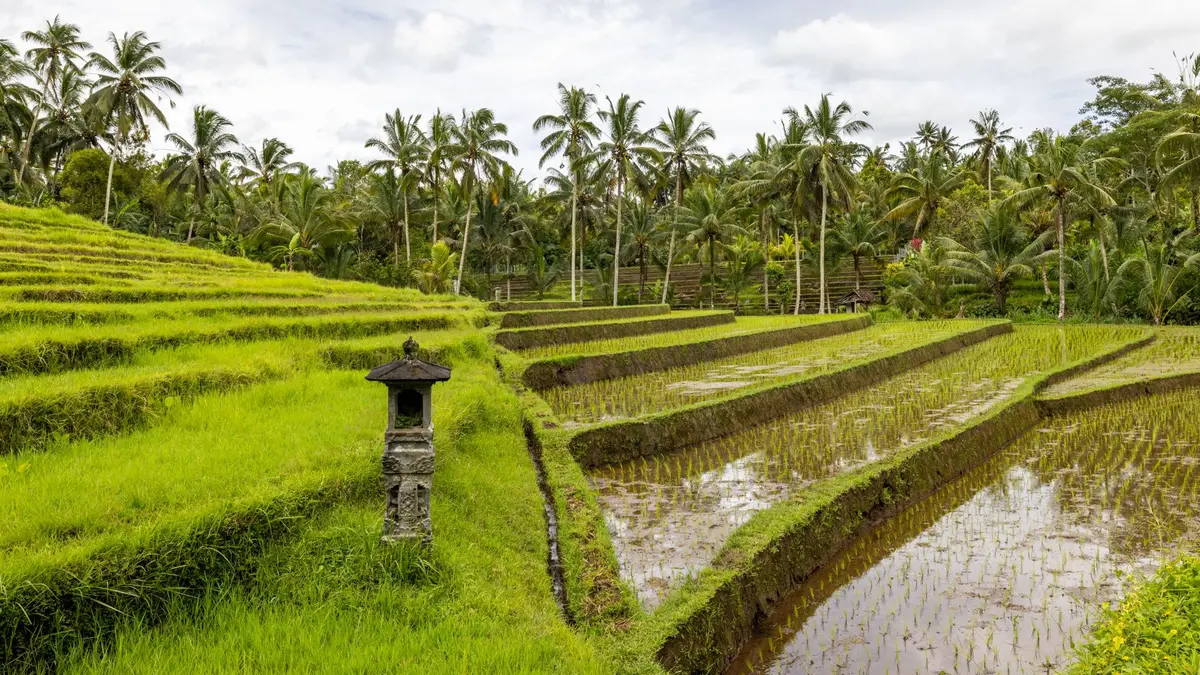
Ubud is the soul of Bali, and staying here is a fundamentally different experience from the coast. Set among rice terraces, river gorges, and tropical forest in the central highlands, Ubud is cooler (both temperature and pace), quieter, and more culturally immersive than anywhere on the beach. This is where you wake up to the sound of roosters and gamelan music instead of surf breaks and DJ sets.
The town itself is compact and walkable — the Ubud Royal Palace, Ubud Market, and the main gallery and restaurant strip along Jalan Raya Ubud are all within a 15-minute walk. The Sacred Monkey Forest Sanctuary sits at the south end of town. But the real magic is outside the centre: the Tegallalang rice terraces are 20 minutes north, the Tirta Empul holy spring temple is 30 minutes northeast, and the Campuhan Ridge Walk — a beautiful morning walk along a narrow ridge between two river valleys — starts at the edge of town.
Yoga and wellness are a major industry here. Studios like Yoga Barn, Radiantly Alive, and Taksu offer drop-in classes all day, and multi-day retreats are widely available. The food scene leans healthy — farm-to-table restaurants, organic cafes, plant-based menus — but excellent Balinese and Indonesian food is everywhere at local warungs.
Accommodation in Ubud ranges from $15 guesthouses in Balinese family compounds to the Four Seasons Resort at Sayan ($600+/night), consistently ranked among Asia's best hotels. The mid-range sweet spot is a jungle or rice-paddy villa with infinity pool — you can find stunning properties with views that would cost ten times more in the Maldives for $80-150/night. Look along Jalan Suweta, Penestanan, or Tegallalang for the best combination of views and value.
- Best for: Couples, solo travellers, culture seekers, yoga enthusiasts, anyone wanting more than beaches
- Budget range: $15-800/night
- Vibe: Spiritual, artistic, health-conscious. Early mornings, early nights.
- Walkable: Town centre yes; outlying villas need transport
- Downsides: No beach, town centre traffic, some over-touristed spots (Monkey Forest queue)
Jungle villas, rice paddy retreats, and luxury resorts — compare Ubud hotels from $15/night.
Compare Ubud Hotels →Uluwatu — Best for Surfers & Clifftop Luxury
The Bukit Peninsula, Bali's southernmost tip, is where the island's geography turns dramatic. Limestone cliffs drop 70 metres into turquoise Indian Ocean water. Hidden beaches — Padang Padang, Bingin, Dreamland, Suluban — sit at the bottom of steep staircases cut into the rock. The Uluwatu Temple perches on a clifftop with one of the most spectacular settings of any temple in Indonesia, and the nightly Kecak fire dance performed at sunset in its amphitheatre is unmissable.
The surf here is world-class. Uluwatu (the break, not the temple) is a long, barrelling left that draws experienced surfers from around the world. Padang Padang produces fast, hollow tubes. Bingin is shorter but punchy. These are not beginner breaks — intermediate to advanced riders only. The surfing community gives the area a laid-back, slightly rugged character that contrasts with the clifftop luxury resorts that have arrived in recent years.
And those resorts are exceptional. Alila Villas Uluwatu (from $400/night) is a stunning piece of architecture perched on the cliff edge. Six Senses Uluwatu (from $500/night) combines sustainability with ultra-luxury. The Edge Bali has a glass-bottomed pool cantilevered over the cliff. For honeymooners and special-occasion travellers, Uluwatu delivers drama that flat-beach destinations cannot match.
Mid-range and budget options exist but are more limited. Guesthouses near Bingin Beach run $25-60/night, and smaller boutique properties along the cliffs go for $80-180/night. The critical thing to know about Uluwatu is that nothing is walkable. The area is spread across several kilometres of clifftop, and you need a scooter or driver to move between beaches, restaurants, and your accommodation. Factor transport into your daily routine.
- Best for: Experienced surfers, honeymooners, luxury seekers, dramatic scenery lovers
- Budget range: $25-700+/night
- Vibe: Dramatic, quieter, spread out, surf-meets-luxury
- Walkable: No — transport is essential
- Downsides: Remote from other areas, nothing walkable, limited nightlife and dining
Clifftop villas, surf lodges, and ultra-luxury resorts — compare Uluwatu hotels from $25/night.
Compare Uluwatu Hotels →Nusa Dua — Best for Families & All-Inclusive Resorts
Nusa Dua is Bali's purpose-built resort enclave, and it makes no apologies for it. The beaches here are protected by an offshore reef, making the water calm, clear, and swimmable year-round — a significant advantage when you have young children or prefer swimming without battling waves and rip currents. The sand is white, the properties are manicured, and the entire area operates as a gated tourism complex with security at the entrance.
This is where the international chains live. The St. Regis Bali (from $350/night), The Mulia (from $300/night), Sofitel Bali Nusa Dua (from $200/night), Hilton Bali Resort (from $180/night), and Grand Hyatt Bali (from $200/night) all offer the full resort experience: multiple pools, kids' clubs, spa, beachfront restaurants, and the kind of operational reliability that families need. You can spend an entire week inside a Nusa Dua resort and never need to leave.
That said, Nusa Dua is the least Balinese part of Bali. The manicured resort zone feels like it could be anywhere in tropical Asia. The local restaurants and street food that define the rest of the island are thin on the ground here, replaced by hotel restaurants and a small selection of mid-range options near the Bali Collection shopping complex. If your priority is cultural immersion, Nusa Dua is the wrong choice. If your priority is a stress-free family beach holiday with reliable quality, it is the right one.
- Best for: Families with children, resort-style holiday seekers, conference attendees
- Budget range: $120-600+/night (few budget options)
- Vibe: Polished, quiet, resort-enclosed, family-friendly
- Walkable: Within the resort zone; limited beyond it
- Downsides: Not authentically Balinese, expensive dining, insulated from the real island
Sanur — Best for a Quiet, Authentic Base
Sanur is the part of Bali that most travellers skip, and that is precisely why certain travellers love it. Located on the southeast coast, Sanur is Bali's oldest beach resort area — it was popular with European visitors in the 1930s — but it never underwent the explosive development that transformed Seminyak and Canggu. The result is a neighbourhood that feels genuinely local: tree-lined streets, traditional warungs alongside modest cafes, a paved beachfront promenade ideal for morning walks and cycling, and a pace that moves at about half the speed of the south coast.
The beach is calm (protected by the same reef system as Nusa Dua) and best at high tide, when it widens considerably. At low tide, the water retreats to expose rocks and seagrass — it is not a beach-all-day destination in the way Seminyak is. But the Sanur boardwalk — a paved path that runs several kilometres along the coast — is one of the most pleasant walks in Bali, especially at sunrise.
Accommodation is notably cheaper than Seminyak or Nusa Dua. Guesthouses and small hotels start at $20-40/night. Mid-range resorts with pools run $60-120/night. The Hyatt Regency Bali (from $150/night) and Prama Sanur Beach (from $100/night) are the main upscale options. Sanur is also the departure point for fast boats to Nusa Penida, Nusa Lembongan, and Nusa Ceningan, making it a practical base if island-hopping is part of your plan.
- Best for: Older travellers, families wanting a quieter alternative, long-stay visitors, island-hopping base
- Budget range: $20-200/night
- Vibe: Relaxed, authentic, residential, early-to-bed
- Walkable: Yes — town centre and beachfront promenade
- Downsides: Beach is tide-dependent, limited nightlife, fewer restaurant choices than the south
Nusa Penida & Lembongan — Best for Snorkelling & Adventure
The three Nusa islands — Penida, Lembongan, and Ceningan (connected by a bridge to Lembongan) — sit off Bali's southeast coast, a 30-to-45-minute fast boat from Sanur. Most visitors do them as a day trip, but staying overnight transforms the experience: you get the dramatic viewpoints and snorkelling sites without the day-trip crowds, and you can catch sunrise at Kelingking Beach or Diamond Beach in solitude.
Nusa Penida is the largest and most dramatic. The T-Rex-shaped cliff at Kelingking is one of the most photographed landscapes in Indonesia. Angel's Billabong and Broken Beach are extraordinary natural formations on the west coast. The snorkelling at Crystal Bay and Manta Point is world-class — manta rays with three-metre wingspans cruise through the water between July and November. Roads on Penida are rough, steep, and poorly maintained; you will need a scooter with good brakes or a local driver with a four-wheel-drive.
Nusa Lembongan is smaller, flatter, and easier to navigate. It has a more developed tourist infrastructure — small beach bars, surf breaks at Playgrounds and Shipwrecks, and mangrove tours. Lembongan is connected by a narrow bridge to Nusa Ceningan, which has the famous (and slightly terrifying) Blue Lagoon cliff jump.
Accommodation on the Nusa islands is more basic than mainland Bali. On Penida, expect simple guesthouses and homestays for $15-40/night, with a handful of newer boutique properties in the $60-120 range. Lembongan has more options: beachfront bungalows from $30-70/night and resort-style properties from $80-200/night. Neither island has luxury hotels on par with the mainland, and that is part of the appeal.
Snorkelling with mantas, Kelingking Beach tours, and fast boat transfers from Sanur.

Budget Picks: $15-50/Night — Hostels, Guesthouses & Losmen
Bali remains one of the cheapest destinations in the world at the budget end. For $15-50 a night, you can stay in clean, comfortable accommodation with genuine Balinese character — often in family-run losmen (traditional guesthouses) where breakfast is included and the owners treat you like a guest in their home rather than a transaction in a system.
What $15-25/Night Gets You
A dorm bed in a well-reviewed hostel in Canggu or Ubud (air-conditioned, locker, communal kitchen, pool in many cases). Or a private room in a basic losmen or family guesthouse — fan-cooled, shared bathroom, simple breakfast of banana pancake or nasi goreng included. Properties at this level are clean and functional but not luxurious. The best ones have open-air common areas, gardens, and a genuine family atmosphere. Look in Ubud (along Jalan Kajeng and Jalan Hanoman), Canggu (Batu Bolong area), and Sanur for the highest concentration of good budget stays.
What $25-50/Night Gets You
A private room with air conditioning, ensuite bathroom, and often a small pool in a boutique guesthouse. In Ubud, this budget can get you a room with a rice paddy view. In Canggu, a room in a small surf hotel with pool and breakfast. In Uluwatu, a basic but clean room within walking distance of Bingin or Padang Padang beach. At $40-50/night, you start entering the territory of small private villas — especially in Ubud and Canggu — with a private plunge pool, making Bali one of the only places in the world where "budget" and "private pool" can coexist in the same sentence.
- Book direct: Many small guesthouses offer 10-20% less than OTA prices if you message them on WhatsApp or Instagram
- Monthly rates: Staying 28+ nights? Ask for monthly pricing — discounts of 30-50% are standard
- Shoulder season: May-June and September rates are 20-40% lower than July-August peak
- Location trade-off: A $30/night room 10 minutes from Ubud centre has better views and more peace than a $50/night room on the main road
Mid-Range Picks: $50-150/Night — Boutique Hotels & Pool Villas
The $50-150/night range is where Bali becomes genuinely extraordinary value. This is the price tier where you can stay in properties that would cost $300-500/night in Europe, Thailand's luxury segment, or the Maldives. The defining accommodation type in this bracket is the private pool villa — and it is what makes Bali one of the most popular mid-range destinations in the world.
Private Pool Villas ($70-150/Night)
A one-to-two-bedroom villa with a private swimming pool, open-air bathroom, full kitchen, daily housekeeping, and a tropical garden. Many include breakfast. In Ubud, the pool often sits on a deck overlooking rice terraces or jungle canopy. In Seminyak and Canggu, the villas tend to be more urban — walled compounds on residential streets — but still offer complete privacy and a pool to yourself. The experience of waking up, walking out of your bedroom, and stepping into your own pool surrounded by frangipani and palm trees, with nobody else around, is the reason people come back to Bali year after year.
The best villa booking platforms are Airbnb, Booking.com, and Agoda. For longer stays (a week or more), negotiate directly with the villa owner — discounts of 15-30% are normal. Check reviews carefully: "private pool villa" in Bali covers everything from a stunning infinity pool overlooking a river gorge to a three-metre plunge pool in a concrete courtyard.
Boutique Hotels ($80-150/Night)
Bali's boutique hotel scene is outstanding. Properties in this range typically have 10-30 rooms, a communal infinity pool with a view, on-site restaurant, and the kind of design-conscious aesthetic that Instagram was built for. Some standouts across areas:
- Ubud: Bisma Eight ($100-150), Komaneka at Bisma ($120-180), Adiwana Resort Jembawan ($80-120)
- Seminyak: The Amala ($100-160), Bali Paragon Resort ($80-130)
- Canggu: Theanna Eco Villa ($90-140), Hotel Tugu Bali ($130-200)
- Uluwatu: Suarga Padang Padang ($120-180), Mana Uluwatu ($90-150)
Pool villas, boutique hotels, and design-forward stays across every Bali region.
Compare Hotels from $50/Night →Luxury Picks: $200+/Night — Private Villas & Resort Picks
Bali's luxury tier competes with anywhere in the world — Maldives, Amalfi Coast, Seychelles — at a fraction of the price. A $400/night villa in Bali delivers a level of space, service, and setting that costs $1,500+ per night in comparable destinations. The island has attracted the world's top hotel brands, and the competition between them means standards are exceptionally high.
Top Luxury Resorts
- Four Seasons Resort Bali at Sayan (Ubud, from $600/night) — Built into a river gorge, this is frequently voted one of Asia's best hotels. The lotus pond entrance, the riverside spa, and the three-tiered infinity pool are iconic. If your budget allows one splurge night in Bali, this is where to spend it.
- Alila Villas Uluwatu (from $400/night) — Dramatic modernist architecture on the cliff edge. The 50-metre infinity pool appears to drop off into the Indian Ocean. Eco-conscious design with cage-free luxury.
- Six Senses Uluwatu (from $500/night) — Sustainability-focused ultra-luxury. Cliff-top setting, alchemy bar, organic garden, and one of the most beautiful spa settings in Bali.
- The Mulia (Nusa Dua, from $300/night) — The gold standard for family-friendly luxury. Massive beachfront property with multiple pools, an enormous spa, and a level of polish that justifies the price.
- Viceroy Bali (Ubud, from $350/night) — Each villa has a private heated pool overlooking a river valley. The sunset cocktail bar and terrace restaurant are destination experiences even if you are not staying.
- COMO Uma Canggu (from $250/night) — The best luxury option in Canggu. Beach club access, surf school, holistic wellness programs, and COMO's signature clean-eating menus.
Private Luxury Villas ($200-1,000+/Night)
For groups, families, or anyone who wants complete privacy, Bali's private luxury villa market is extraordinary. Multi-bedroom estates with private staff — a cook, housekeeper, gardener, and sometimes a driver — are available from $200-500/night for a three-to-four-bedroom property. At the top end, six-to-eight-bedroom compounds with private beaches, home cinemas, and full event capabilities run $1,000-3,000/night — still a fraction of what comparable properties cost in the Caribbean or Mediterranean.
Specialist villa booking agencies like The Luxe Nomad, Elite Havens, and Bali Luxury Villas curate vetted properties and handle the concierge, staffing, and logistics. For groups of six or more, a private villa almost always offers better value per person than individual hotel rooms, with dramatically more space and a private pool.
Transport Between Areas — Grab, Private Driver & Scooter Rental
Understanding transport is essential for choosing where to stay, because moving between Bali's areas takes much longer than the map suggests. The island has no rail network, no metro, and no reliable bus system. The roads are narrow, frequently congested, and often shared with ceremonial processions, stray dogs, and overloaded trucks. Here are your practical options and how they affect your accommodation choice.
Grab (Ride-Hailing)
Grab works across most of Bali and is the cheapest point-to-point option. A 20-minute ride costs roughly 30,000-60,000 IDR ($2-$4). However, Grab is informally banned in certain tourist areas — notably parts of Seminyak and Ubud centre — due to pressure from local taxi driver associations. You may need to walk to a main road for pickup. Best for short hops within one region. Not ideal for cross-island travel.
Private Driver (Best for Day Trips)
Hiring a private driver with an air-conditioned car for a full day (8-10 hours) costs $35-50 USD and is the single smartest transport decision in Bali. Your driver handles navigation, parking, local knowledge, and the maddening traffic so you don't have to. For a day trip from Ubud to the waterfalls and temples in the north, or a circuit of Uluwatu's beaches, a private driver is dramatically more efficient and comfortable than any alternative. Ask your hotel to recommend one, or book via GetYourGuide. Tip 10-15% for good service.
Scooter Rental
Scooter rental costs 60,000-80,000 IDR ($4-$5) per day and gives you total freedom. However, you legally need an International Driving Permit with a motorcycle endorsement. Police checkpoints targeting tourists without permits are common — especially around Canggu — with on-the-spot fines of 500,000 IDR ($31). Bali traffic is chaotic and the roads are unpredictable. If you are not an experienced rider, do not rent a scooter. Hospital visits from scooter accidents are one of the most common tourist insurance claims in Bali.
Key Drive Times (Approximate)
| Route | Distance | Drive Time |
|---|---|---|
| Airport to Seminyak | 12 km | 20-40 min |
| Airport to Ubud | 37 km | 60-90 min |
| Airport to Uluwatu | 20 km | 30-50 min |
| Seminyak to Canggu | 10 km | 20-40 min |
| Seminyak to Ubud | 30 km | 50-80 min |
| Ubud to Uluwatu | 50 km | 80-120 min |
| Sanur to Nusa Penida | Fast boat | 30-45 min |
The most efficient Bali trip splits your accommodation between two bases — typically Ubud + one coastal area (Seminyak, Canggu, or Uluwatu) — rather than staying in one place and driving back and forth. Move once mid-trip instead of commuting daily. Use a private driver for day trips that cover multiple stops, and Grab for short evening rides within your base area.
Private drivers, airport transfers, island-hopping ferries, and guided day trips.
Best Time to Visit Bali
Bali sits 8 degrees south of the equator. The temperature stays at 27-30C (80-86F) year-round. What changes is the rain — and the rain determines crowds, hotel prices, and how your accommodation choice plays out in practice.
May-June and September are the sweet spot for accommodation value. The weather is dry and sunny, but the European and Australian school holiday crowds have not yet arrived (or have just left). Hotel prices are 20-40% lower than July-August peak season, and you will not need to book weeks in advance for popular properties. If you can time your trip, these months deliver the best combination of weather, availability, and price.
July-August is peak season. The weather is perfect — dry, clear, breezy — but hotel rates hit their annual maximum. Popular villas and boutique hotels sell out weeks in advance. Beach clubs are packed. Book two to three months ahead if travelling during this window, especially if you want a specific property.
November-March (wet season) brings daily tropical downpours, usually in the afternoon, lasting one to three hours. Mornings are often clear and beautiful. Hotel rates drop 30-50% across the island. The landscape is at its most lush and green — rice terraces and jungle canopies look extraordinary. If you can tolerate afternoon rain (and you are mostly spending that time at your villa's pool anyway), wet season Bali is excellent value with dramatically fewer crowds.
The impact on accommodation choice: during wet season, prioritize properties with covered outdoor areas, good pool access, and indoor living spaces. Open-air villas without rain coverage lose their appeal when it rains for two hours every afternoon. Resorts with multiple restaurants and spa facilities (Nusa Dua properties, larger Ubud resorts) hold up better in wet season than basic guesthouses where you are stuck in your room during downpours.
- Budget guesthouse: $15-25/night year-round (minimal seasonal variation)
- Mid-range pool villa: $60-80/night wet season, $90-150/night dry season, $120-180/night peak (Jul-Aug)
- Luxury resort: $200-350/night wet season, $350-550/night dry season, $450-800/night peak
- Private luxury villa: $150-250/night wet season, $250-400/night dry season, $350-600/night peak
Hotels, tours, activities, and inter-island ferries — compare and book everything you need.
Ready to plan your Bali trip?
Tell Tripva your travel dates, budget, and travel style — and we'll build a complete day-by-day Bali itinerary with hotel recommendations for each area, activity timing, and transport between bases. Takes 30 seconds.
Plan Your Bali Trip ✦