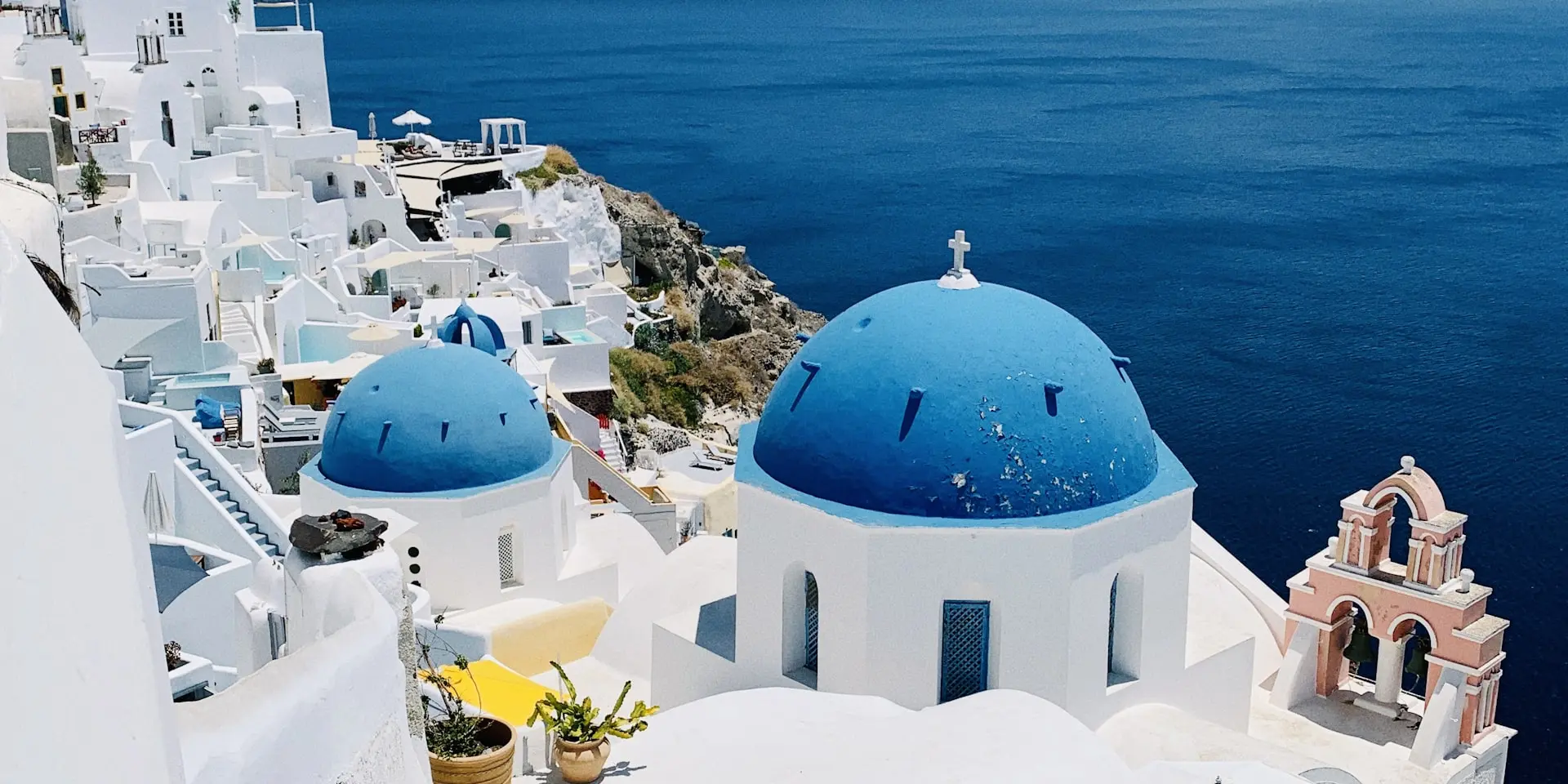
Why Santorini
Around 1600 BCE, a volcanic eruption tore the centre out of a circular island in the southern Aegean and left behind a crescent-shaped cliff face plunging 300 metres into a flooded caldera. That cliff is now lined with white-washed villages, blue-domed churches, and infinity pools cantilevered over one of the most dramatic geological theatres on Earth. Santorini is not just a pretty Greek island — it is a landscape that should not exist, and everything about visiting it is shaped by that fact.
The caldera is the reason the sunsets look the way they do: the western-facing cliff catches the light as it drops behind the volcanic islets of Nea Kameni and Palea Kameni, and the water in the flooded crater turns from sapphire to copper to ink. It is the reason the villages stack vertically rather than sprawl — there is no flat ground on the caldera side, only terraced rock. And it is the reason the beaches are black, red, and grey instead of white: this is volcanic soil, pumice, and oxidised lava, not Caribbean coral sand.
Santorini rewards the traveller who understands its geography. The caldera-facing west coast is where you go for views, sunsets, fine dining, and cave hotels carved into the pumice. The eastern coast is where you go for beaches, lower prices, and a quieter pace. The interior villages are where you find the Santorini that locals actually live in. This guide covers all three.
The Villages: Where to Stay and What to See
Oia — The Sunset Icon
Oia (pronounced "ee-ah") is the village you have seen in every photograph of Santorini: blue-domed churches, white cave houses cascading down the cliff, and a ruined Venetian castle at the northern tip where hundreds of people gather each evening for the sunset. It is genuinely as beautiful as the photographs suggest, and it is also genuinely crowded between 6pm and 8pm from June through September.
The trick to Oia is timing. Walk the marble-paved main street at 7:30am and you will have it nearly to yourself — the cruise ship passengers have not arrived yet, the day-trippers from Fira are still at breakfast, and the light on the caldera is soft gold rather than the flat white of midday. The famous blue domes (Ekklisia Anastaseos and the Three Bells, which sit just below the main path near the steps to Ammoudi Bay) photograph best in the morning when the sun is behind you and the domes pop against the deep blue sea.
Stay in Oia if: you want the most photogenic village, you are willing to pay premium prices (expect EUR 250–600+ per night for a caldera-view cave hotel in high season), and you do not mind navigating crowds in the evening.
Do not miss: the 300-step walk down to Ammoudi Bay for lunch at one of the seafood tavernas on the water. Order the grilled octopus and the fried tomato balls (tomatokeftedes) — the tomatoes grown in Santorini's volcanic soil are intensely sweet and unlike anything you have tasted elsewhere. After lunch, swim off the rocks below the tavernas — the water is deep, clear, and astonishingly blue.

Fira — The Capital with Edge
Fira is Santorini's capital and its most energetic village. Where Oia is curated and photogenic, Fira is messy and alive — a jumble of shops, restaurants, bars, and churches stacked along the caldera rim with views that rival Oia at a fraction of the price. The nightlife here is the best on the island, centred around the caldera-edge bars where you can drink with a 300-metre drop to the sea below.
The cable car from the Old Port to Fira town is a three-minute ride and one of the most efficient pieces of tourist infrastructure in all of Greece. It runs every 20 minutes and costs EUR 6. The alternative is 588 steps on foot, which is a legitimate workout but worth doing once for the views — or you can ride a donkey, though the animal welfare concerns are real and most conscientious travellers now skip this.
Stay in Fira if: you want walkable restaurants and bars, easier bus connections to the rest of the island, and caldera views without Oia prices. Budget caldera-view rooms start around EUR 120–180 in shoulder season.
Imerovigli — The Quiet Balcony
Imerovigli sits at the highest point of the caldera rim, about a 25-minute walk north of Fira along a paved clifftop path. It has the best views on the island — you can see north to Oia and south past Fira — but only a handful of hotels and restaurants. This is the village for honeymooners and anyone who wants the caldera experience without the noise.
The hike from Imerovigli to Oia takes about two hours along the caldera edge and is the single best walk on Santorini. The path passes the dramatic rock formation of Skaros Rock (a ruined Venetian fortress on a narrow promontory — worth the 20-minute detour to the tip) and threads through scrubland with constant views of the caldera, the volcanic islands, and the open Aegean. Start early to avoid the midday heat, carry water, and wear proper shoes — the path has loose gravel sections.
Pyrgos — The Local Secret
Pyrgos is the medieval hilltop village that most visitors drive through on the way to somewhere else, and that is exactly why you should stop. It is the highest village on Santorini, built around a Venetian castle (kasteli) whose narrow lanes, barrel-vaulted passages, and stone staircases feel like a maze designed to confuse invading pirates — because that is exactly what they were. Climb to the top of the kasteli for 360-degree views of the entire island: the caldera to the west, the flatlands and vineyards to the east, the airport runway, and the sea on every side.
Pyrgos has excellent restaurants at half the price of Oia — try Franco's or Selene (the latter is one of Santorini's most respected fine dining spots, with a strong focus on local ingredients and volcanic terroir wines). The village is also the starting point for several vineyard visits. Santorini's indigenous Assyrtiko grape produces one of the most distinctive white wines in the Mediterranean: bone-dry, mineral-driven, with a salinity that comes directly from the volcanic soil and the sea wind. Visit Santo Wines or Venetsanos Winery for tastings with caldera views.
Akrotiri — The Archaeological Village
Akrotiri is a working village at the southern tip of the island, and it is home to Santorini's most important cultural site: the Minoan ruins, sometimes called the "Pompeii of the Aegean." The settlement was buried by the same volcanic eruption that created the caldera around 1600 BCE and preserved an advanced Bronze Age city — multi-storey buildings, drainage systems, wall frescoes, and ceramic workshops — in remarkable condition under metres of volcanic ash.
The archaeological site is now covered by a modern bioclimatic roof and walkways. Entry costs EUR 12, and you should budget 60–90 minutes. A guided tour (book through the site or your hotel) adds enormous context — the preserved frescoes alone tell stories about Minoan naval power, trade routes, and daily life that are difficult to appreciate without narration. The famous "Boxing Boys" and "Spring Fresco" originals are in the National Archaeological Museum in Athens, but high-quality reproductions are displayed at the Museum of Prehistoric Thera in Fira, which is worth an hour of your time.
Compare prices across hundreds of Santorini hotels — from budget rooms in Kamari to luxury caldera-view suites in Oia and Imerovigli.
Compare Hotel Prices →Beaches Worth the Trip
Santorini's beaches are not for the traveller who wants sugar-white sand and calm turquoise water. They are for the traveller who wants geology you can sit on. Every beach here tells the story of the eruption: black sand from basalt, red sand from oxidised iron in the lava, white cliffs from compacted pumice. Bring water shoes — the dark sand gets scorching hot in summer.
Red Beach (Kokkini Paralia)
A dramatic cove below towering red and black volcanic cliffs near Akrotiri. The red colour comes from iron-rich lava that oxidised on contact with air and water. The beach itself is small — maybe 100 metres of coarse red and black pebble — and gets crowded by midday in summer. Access is a 10-minute walk from the car park along a cliff path that involves some scrambling (wear proper footwear, not flip-flops). There have been rockfall incidents, and warning signs are posted. The cliffs are unstable. Swim here, take the photograph, but do not linger directly under the cliff face.
Perissa (Black Sand)
Perissa is Santorini's longest beach — a 7-kilometre stretch of fine black volcanic sand backed by the sheer cliff of Mesa Vouno, the mountain that separates Perissa from Kamari on the other side. This is where you come for a proper beach day: sunbeds, beach bars, water sports, and tavernas right on the sand. The water is clean, deepens gradually, and the dark sand gives it an almost Caribbean turquoise tone in the shallows. Perivolos, the continuation of Perissa to the south, has a younger, more party-oriented vibe with DJ sets at beach clubs like JoJo Beach and Wet Stories.
Kamari
Kamari is Perissa's more organised twin on the north side of Mesa Vouno. It has a long promenade lined with restaurants, an open-air cinema (Cine Kamari — catch a film under the stars for EUR 9), and a Blue Flag beach. The sand is dark grey-to-black pebble, and the water is clean and calm. Kamari is a good base if you want a beach-focused stay without caldera prices — hotels here run EUR 60–120 per night, and the bus to Fira takes 20 minutes.
Vlychada
Vlychada is the beach for people who want to feel like they have landed on the moon. The backdrop is a wall of white and grey pumice cliffs sculpted by wind and water into surreal shapes — pillars, ridges, and hollows that look extraterrestrial. The beach itself is grey pebble and dark sand, and it is rarely crowded because it is further south and harder to reach than Perissa or Kamari. A small marina sits at one end. Bring your own water and shade — there are minimal facilities.
White Beach (Aspri Paralia)
White Beach is accessible only by boat from Red Beach or Akrotiri port (small water taxis run in season for EUR 5–8 per person). The cliffs here are white pumice, and the beach is a narrow strip of white pebble and grey sand beneath them. It is quieter than Red Beach and feels more remote, though sunbed operators do set up in summer. The swimming is excellent — the water is deep and clear within a few metres of shore.

When to Visit: Month-by-Month
Santorini's season runs roughly from April through October, with a sharp peak in July and August. The island does not shut down entirely in winter, but most hotels, restaurants, and tourist services close from November through March. The sweet spots are June and September — warm enough to swim, light enough to photograph, and manageable enough to enjoy without fighting for a restaurant table.
April: The island is waking up. Temperatures hit 18–20C, wildflowers cover the hillsides, and many hotels and restaurants reopen mid-month. Not all boat tours and beach clubs are running yet, but the caldera hike from Fira to Oia is at its most beautiful — green scrub, no haze, cool air. Water temperature is around 17C, so swimming is for the brave.
May: A genuinely excellent month. Warm days (22–25C), cool evenings, and crowds that are a fraction of what they will be in six weeks. The sea is warming up (19–20C), most services are operational, and hotel prices are 30–40% below July rates. If you only have one week for Santorini and want the best balance of weather, price, and crowd level, late May is the answer.
June: The first sweet spot. Temperatures reach 27–30C, the sea is swimmable at 22–23C, the light is long and golden, and the crowds have not yet reached their July crescendo. Prices are rising but still below peak. Early June is particularly good — you get summer conditions without summer congestion.
July and August: Peak season. Temperatures regularly hit 33–36C, the meltemi wind blows strong from the north (which actually helps with the heat but can make ferry crossings rough), and every caldera-view restaurant requires a reservation. Cruise ships disgorge thousands of day-trippers into Fira and Oia. Prices are at their highest. The upside: the water is 25–26C, the sunsets are reliably clear, and the energy of the island is at full throttle. If you come in August, book everything in advance and avoid Oia between 5pm and 8pm unless you enjoy being shoulder-to-shoulder.
September: The second sweet spot, and arguably the best single month to visit. Temperatures are still 27–29C, the sea is at its warmest (25C), the summer crowds thin out noticeably after the first week, and prices begin to drop. The light takes on a warmer, more amber quality that photographers love. The grape harvest is underway — visit the wineries during this period for the most activity and the freshest must tastings.
October: Still warm (22–24C) with occasional rain. The sea remains swimmable at 22–23C. Many services begin winding down in the second half of the month. This is excellent value — hotels that charge EUR 400 in August may be EUR 150 in October — and the island feels calmer and more local. Some restaurants and boat tours stop operating after mid-October.
November through March: Most tourist infrastructure closes. The island reverts to a quiet community of about 15,000 year-round residents. The weather is mild by northern European standards (12–16C) but grey and rainy, and the wind can be fierce. A handful of restaurants in Fira stay open year-round, and there is a stark, melancholy beauty to the empty caldera villages. But this is not a beach holiday — it is a contemplative one.
Getting There and Around
Ferries from Athens
Most travellers arrive by ferry from the port of Piraeus (Athens). Two main operators serve the route:
- Blue Star Ferries (conventional): Departs Piraeus daily, usually around 7:30am. Journey time is approximately 7.5–8 hours. Tickets start at EUR 40 for deck class, EUR 55–70 for assigned seats, and EUR 80–120 for cabins. The ships are large and stable — good for families and anyone prone to seasickness. Book at bluestarferries.com or through Ferryhopper.
- SeaJets (high-speed catamaran): Multiple daily departures. Journey time is 4.5–5 hours. Tickets range from EUR 60–90. The catamarans are faster but feel the waves more — if the meltemi is blowing (common July–August), the ride can be rough. SeaJets also connect Santorini to Mykonos (2.5 hours), Naxos (1.5 hours), Paros (2.5 hours), and Crete (2 hours).
Book ferries 2–4 weeks ahead in July and August — high-speed services sell out. Use Ferryhopper to compare schedules and prices across operators. Ferries dock at Athinios Port, which is a 20-minute drive from Fira. Pre-book a transfer or take the public bus (EUR 2.50) that meets every ferry.
Flights
Santorini (Thira) Airport (JTR) receives direct flights from Athens (45 minutes, multiple daily on Aegean Airlines and Sky Express, EUR 50–120 one way), plus seasonal direct flights from London, Paris, Rome, Milan, Munich, and other European cities. The airport is tiny — expect chaos at check-in during peak season. Arrive two hours before your flight. A taxi from the airport to Fira costs EUR 20–25; to Oia, EUR 30–40.
Getting Around the Island
Santorini is small — about 18 km long and 5 km wide at its widest — but the roads are narrow, winding, and chaotic in summer. Your options:
- ATV / Quad rental: The most popular choice for couples. Costs EUR 25–40 per day. Gives you freedom to reach beaches and villages on your own schedule. The downside: the roads are dangerous, especially at night and when the meltemi kicks up dust. Accidents are common, and Greek hospital bills are not cheap. Wear a helmet (required by law, often not enforced), and make sure your travel insurance covers motorcycle/ATV use — many policies exclude it by default.
- Public bus (KTEL): Reliable and cheap. Buses run from Fira's central station to Oia (EUR 1.80, 25 min), Kamari (EUR 1.80, 15 min), Perissa (EUR 2.50, 20 min), Akrotiri (EUR 2.50, 20 min), and the airport and port. Frequency drops sharply after October. Schedules at ktel-santorini.gr.
- Private transfer / taxi: Pre-book through your hotel or use the Santorini Taxi app. Taxis are metered but scarce — there are only about 25 on the island. A private transfer from the port to Oia costs EUR 35–45.
- Car rental: Useful if you want to explore the eastern beaches and interior villages at your own pace. Roads are tight, and parking in Oia and Fira is a nightmare. Book the smallest car available — you will need it for the lanes. EUR 35–60 per day in summer.
Ferries from Athens, flights to Thira (JTR), and car rental for exploring the island at your own pace.
Photo Spots — Three Unmissable Frames
-
1Blue Domes from Firostefani (Three Bells of Fira)The most-photographed composition in all of Santorini is actually in Firostefani, not Oia or Fira. The three blue domes of the Catholic Church of the Dormition sit below the walkway on the caldera path between Fira and Imerovigli. From the small terrace above, you get the domes in the foreground, the caldera and volcanic islands in the middle ground, and Oia glowing white on the distant cliff. This is the "National Geographic shot" — the one that sells Santorini to the world. It is most often incorrectly captioned as being in Oia.Best time: Early morning (7–9am) for front-lit domes and empty walkway. The terrace is small — at sunset it is packed 30 people deep.
-
2Skaros Rock, ImerovigliA jagged volcanic promontory jutting out into the caldera from Imerovigli, topped with the ruins of a 13th-century Venetian fortress. The 20-minute scramble to the tip of Skaros gives you 360-degree views — the caldera below, the white villages clinging to the cliff on either side, and the open Aegean stretching to the horizon. The rock itself is photogenic from every angle: from the Imerovigli path looking out, from the tip looking back at the village, and from a drone overhead showing the narrow spine of rock dropping vertically into the sea.Best time: Late afternoon, 1–2 hours before sunset. The warm light hits the rock face and the village behind you glows gold. Bring water and wear grippy shoes.
-
3Red Beach, AkrotiriThe collision of red and black volcanic cliffs with the deep blue Aegean is one of the most surreal coastal landscapes in Europe. The colour comes from iron-oxide-rich scoria — essentially rusted lava — and the contrast against the blue water and white surf is extraordinary. The best photograph is taken from the viewing platform at the end of the access path, looking down at the beach and cliff face before you descend. From the beach itself, shoot upward with a wide lens to capture the full scale of the cliffs towering above you.Best time: Midday when the sun is directly overhead and the red colour is most saturated. Morning light leaves the cliff in shadow.

Sunset sailing cruises, volcano boat tours, wine tastings, and guided archaeological walks — book with free cancellation.
Budget Quick Facts
- Caldera-view hotel (Oia/Imerovigli): EUR 250–600+ per night (Jul–Aug), EUR 120–300 (May/Jun/Sep/Oct)
- Non-caldera hotel (Fira/Kamari/Perissa): EUR 60–150 per night in summer
- Meal at a taverna: EUR 12–20 per person for a main course with drink
- Fine dining (caldera view): EUR 60–100 per person
- Ferry from Athens (Blue Star): EUR 40–70 depending on seat class
- Ferry from Athens (SeaJets high-speed): EUR 60–90
- Flight from Athens: EUR 50–120 one way
- Akrotiri archaeological site: EUR 12 entry
- Museum of Prehistoric Thera: EUR 6 entry
- Caldera boat tour (volcano + hot springs): EUR 25–45 per person
- Sunset sailing catamaran: EUR 100–180 per person (includes dinner and drinks)
- ATV rental: EUR 25–40 per day
- Bus fare (Fira to Oia): EUR 1.80
- Daily budget (mid-range): EUR 150–220 per person per day (accommodation, meals, transport, one activity)
Santorini is not a budget destination in peak season, but you can bring costs down significantly by visiting in May or October, staying on the east coast (Kamari or Perissa), eating at local bakeries and souvlaki spots in Fira rather than caldera-view restaurants, and using the bus instead of renting a vehicle. A couple can do Santorini comfortably for EUR 120–160 per day total in shoulder season by making these choices — and the experience is arguably better than the EUR 500-per-night peak-season version, because the island is calmer, the light is softer, and the locals have time to talk to you.
Everything you need in one place — hotels, tours, ferry tickets, and car rental for your Santorini holiday.
Ready to plan your Santorini trip?
Tell Tripva your travel dates, interests, and pace — and we'll build a complete day-by-day Santorini itinerary with hotel picks, ferry logistics, restaurant recommendations, and timing tips. Takes 30 seconds.
Plan Your Santorini Trip ✦