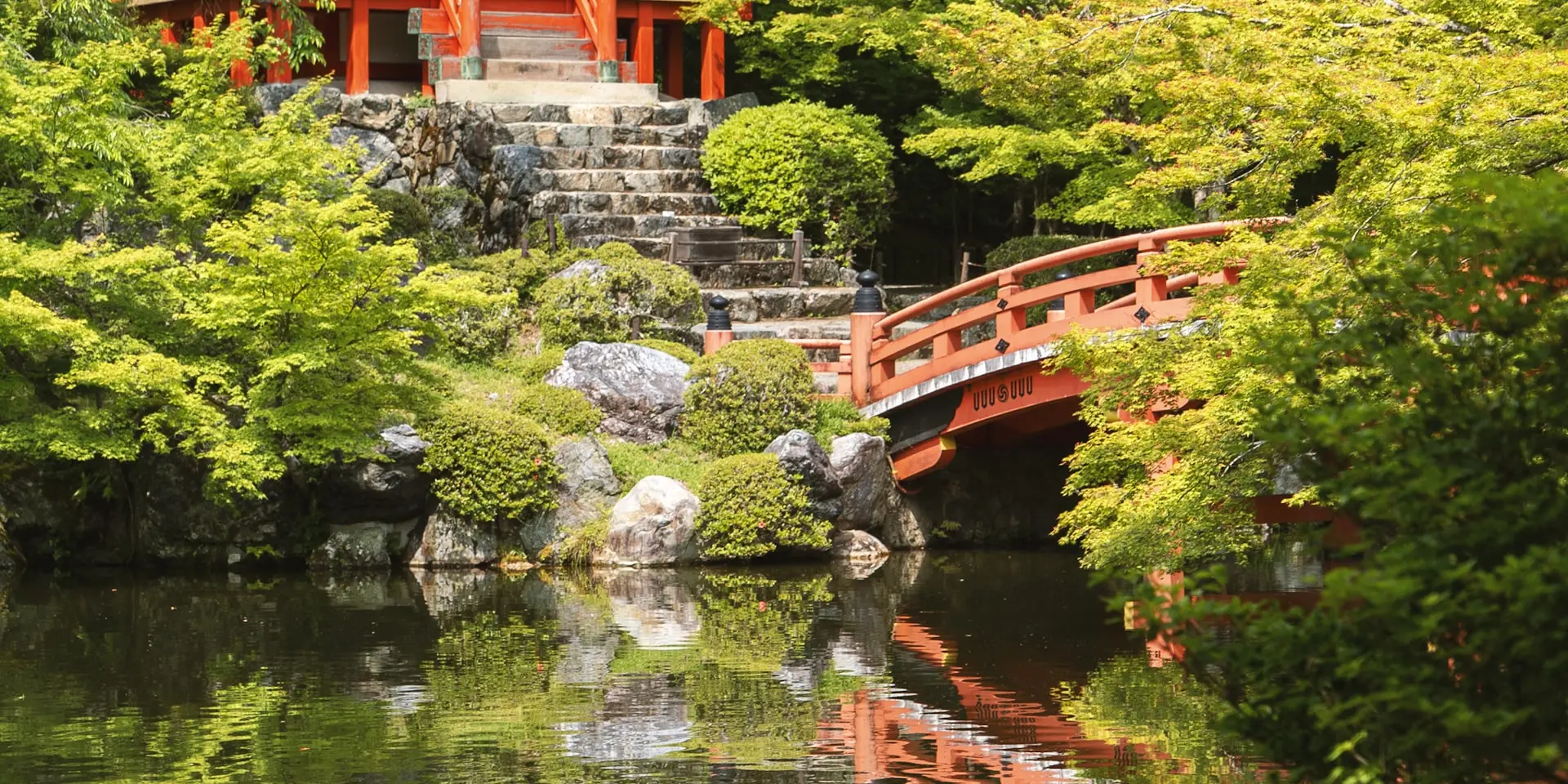
Kyoto has over 2,000 temples and shrines. That number sounds impressive until you realize it means most of them are forgettable — small neighbourhood halls with nothing to distinguish them from the one three blocks away. The tourist circuit herds everyone through the same five, often at the worst possible time of day. This guide cuts the list to the 12 that genuinely deliver something you cannot experience anywhere else on the planet, and tells you exactly when and how to visit each one so the experience matches the photographs.
Before we start: a quick vocabulary note that will save you confusion on the ground. Temples are Buddhist. They end in -ji, -dera, or -in. You will see incense burners, Buddha statues, and monks in grey or saffron robes. Shrines are Shinto. They end in -jinja, -taisha, or -gu. You will see torii gates, sacred rope (shimenawa), and fox or lion-dog guardian statues. Many compounds contain both — Japanese religious syncretism means the boundaries have been porous for over a thousand years. Nobody will judge you for mixing them up, but knowing the difference enriches every visit.
Why Kyoto's Temples Are Different
Kyoto was Japan's imperial capital for over a millennium — from 794 to 1868. Unlike Tokyo, Osaka, and most other major Japanese cities, it was deliberately spared from Allied bombing during World War II (partly due to its cultural significance, partly due to lobbying by scholars who knew what would be lost). The result is a city where 17 UNESCO World Heritage Sites sit within an area you can cross by bicycle in 40 minutes.
What makes Kyoto's temples different from, say, Bangkok's or Bali's is the design philosophy. These are not monuments built to overwhelm with scale or gold leaf (with one notable exception). They are spaces designed to produce a specific emotional response — contemplation, seasonal awareness, the Japanese aesthetic concept of wabi-sabi. A rock garden at Ryoan-ji is 15 stones on raked gravel. It has held visitors in silence for 500 years. That is what Kyoto does at its best.
The temples that make this list were chosen on three criteria: architectural or artistic significance that you cannot replicate elsewhere, a specific experience that rewards the effort of getting there, and practical visitability — meaning there is a time window when the crowds thin enough that the place functions as it was designed to.
The Essential Five
These are the temples and shrines that belong on every Kyoto itinerary regardless of season, interest, or time constraint. If you have only two days in Kyoto, these five are your list.
Kinkaku-ji (Golden Pavilion)
The three-storey pavilion covered in gold leaf, reflected in its mirror pond (Kyoko-chi), is probably the single most photographed building in Japan. It was originally built in 1397 as a retirement villa for Shogun Ashikaga Yoshimitsu, converted to a Zen temple after his death, burned down by a mentally ill monk in 1950 (Yukio Mishima wrote a novel about it), and rebuilt in 1955 with even more gold leaf than the original. A guided tour of the Golden Pavilion adds historical context that the on-site English signage barely scratches.
When to go: First thing in the morning — gates open at 9am, arrive by 8:45am. The pond is calmest before 10am, and the reflection shot requires still water. In winter, Kinkaku-ji after fresh snowfall is one of the most extraordinary sights in all of Japan — the gold against white is genuinely otherworldly. Check the Kyoto weather forecast and be ready to go at dawn if snow is predicted overnight.
Skip if: You arrive after 11am on a weekend between March and November. The crowds will be four-deep at every viewpoint and the experience becomes a shuffling queue rather than a moment of beauty.

Fushimi Inari-taisha
Ten thousand vermilion torii gates march up the forested slopes of Mount Inari in an unbroken corridor of orange. It is the head shrine of Inari, the Shinto deity of rice, sake, and commerce — which is why Japanese businesses have donated gates here for centuries. Each gate bears the name of its donor in black kanji characters. If you want the stories behind the gates, a guided Fushimi Inari tour explains the symbolism most visitors walk right past.
When to go: At 6am or after 6pm. The shrine is open 24 hours and free to enter — one of Kyoto's only major sites with no admission charge. At midday, the lower torii tunnel is a slow-moving queue of selfie sticks. At dawn, you will have entire corridors to yourself. The full hike to the summit of Mount Inari takes about 2 hours round trip and most tourists quit at the first rest stop (Yotsutsuji intersection, about 45 minutes up). Everything above that point is yours alone.
Pro tip: The torii photograph best from below, looking uphill, with morning light filtering through the gaps. Bring a wide-angle lens or use your phone's ultra-wide mode.
Kiyomizu-dera
Built into the hillside of eastern Kyoto, Kiyomizu-dera's famous wooden stage (butai) juts out 13 metres over the valley on 139 massive zelkova pillars — assembled without a single nail. The Japanese expression "jumping off the stage at Kiyomizu" means taking the plunge on a big decision. (In the Edo period, people actually did jump, believing they would survive if their wish was sincere. The survival rate was about 85%.)
When to go: The approach up Higashiyama through the narrow lanes of Ninenzaka and Sannenzaka is part of the experience — traditional wooden machiya houses, ceramic shops, matcha ice cream stands. Consider joining a guided Higashiyama walking tour to learn the history behind each lane. Arrive by 6am when the temple opens (yes, 6am) to see the stage with the city laid out below in morning mist. Autumn illumination evenings (mid-November to early December) are magical — the temple stays open until 9pm and the maple trees are lit from below.
Skip if: You are claustrophobic about crowds. Kiyomizu sees 5 million visitors per year and the platform can feel genuinely uncomfortable at peak hours. Weekday mornings or illumination evenings are the pressure valves.
Ryoan-ji
Fifteen stones arranged on a rectangle of raked white gravel. No trees, no water, no colour. It is the most famous rock garden (karesansui) in the world and it has been confounding visitors since a Zen monk laid it out sometime in the late 1400s. The garden is designed so that from any seated position on the viewing platform, you can only see 14 of the 15 stones — the idea being that completeness is visible only through enlightenment.
When to go: Opening time (8am, or 8:30am December through February). Sit on the wooden veranda and give yourself at least 20 minutes. The garden works on you slowly. Rushing through in 5 minutes with a photograph is missing the entire point. The larger temple grounds include a beautiful moss garden and a mirror lake that most visitors skip entirely.
Ginkaku-ji (Silver Pavilion)
Despite its name, Ginkaku-ji was never actually covered in silver. Shogun Ashikaga Yoshimasa planned to silver-leaf it to rival his grandfather's Golden Pavilion, but the Onin War bankrupted the project and the bare wood remained. The result, paradoxically, is more beautiful than Kinkaku-ji — the dark wood against the surrounding moss garden is the very definition of wabi-sabi, the Japanese aesthetic of beauty in imperfection and impermanence.
When to go: Mid-morning, any season. Ginkaku-ji handles crowds better than most temples because the circular walking path through the moss garden naturally disperses visitors. The moss garden is the real star — over 100 varieties of moss carpet the hillside in shades of green that photograph best on overcast or lightly rainy days. Walk the Philosopher's Path (Tetsugaku no Michi) south toward Nanzen-ji afterward — it is one of Kyoto's finest strolls, lined with cherry trees in spring and maples in autumn.
The Hidden Seven
These seven temples and shrines are where Kyoto starts to feel like a secret. Most visitors never reach them, which means you get the experience the temples were actually designed to provide — stillness, beauty, and space to think.
Tofuku-ji
In November, the Tsutenkyo Bridge at Tofuku-ji becomes the single best autumn foliage viewpoint in Kyoto — a sea of red and orange maple canopy stretching below a wooden covered bridge. The rest of the year, Tofuku-ji's Zen gardens (redesigned in 1939 by the visionary landscape architect Mirei Shigemori) are among the most artistically daring in Japan — checkerboard moss squares, concentric raked sand circles, and an abstraction of the Milky Way in stone. The temple is the head of the Rinzai school and its scale is massive — 25 sub-temples occupy the compound.
Best time: Mid-November for foliage. Any weekday morning for the gardens alone. Arrive at opening (9am) because by 10:30am in November the bridge is a traffic jam.
Nanzen-ji
A Roman aqueduct running through a Zen temple compound sounds like a fever dream, but there it is — the Suirokaku, a red-brick waterway built in 1890 to channel water from Lake Biwa into Kyoto. It is one of the most unexpected and photogenic juxtapositions in the city. Beyond the aqueduct, Nanzen-ji itself is the head temple of the Rinzai Zen school, with massive wooden gates (the Sanmon is enormous — climb it for panoramic views), a famous tiger-and-bamboo sliding door painting, and a sub-temple garden (Tenju-an) that rivals Ryoan-ji without the crowds.
Best time: Late afternoon. The aqueduct photographs best with western light filtering through its arches. Walk here from the Philosopher's Path for a natural end to an eastern Kyoto day.
Daitoku-ji
A walled compound in northern Kyoto containing 24 sub-temples, of which only a handful are open to the public at any given time. This is the intellectual heart of Zen in Japan — Sen no Rikyu developed the tea ceremony here, and many of the gardens are attributed to the great masters. Daisen-in has a dry landscape garden that reads like a three-dimensional ink painting. Koto-in has an approach path through towering maples that in autumn becomes a tunnel of fire. Zuiho-in has a hidden Christian garden (a cross of stones, from the era when Christianity was banned). Almost no tourists come here.
Best time: Any time. That is the point. Daitoku-ji rarely gets crowded because it is off every standard itinerary and the compound is large enough to absorb visitors. Allow 2 hours to explore 3-4 sub-temples.
Byodo-in (Uji)
You have seen this temple every day of your life if you have ever held a Japanese 10-yen coin — the Phoenix Hall (Hoo-do) is stamped on the back. Built in 1053, it is the finest surviving example of Heian-period Pure Land Buddhist architecture. The building was designed to resemble a phoenix landing on water, with its reflection in the pond completing the form. The interior houses a gold-leaf Amida Buddha by the master sculptor Jocho and 52 wooden bodhisattvas suspended on clouds.
Getting there: 20 minutes from Kyoto Station by JR Nara Line to Uji. The town of Uji is also the matcha capital of Japan — stop at Nakamura Tokichi or Tsuen Tea for the best ceremonial-grade matcha you will ever drink. Combine with a walk along the Uji River for a half-day trip.
Sanjusangen-do
One thousand and one life-sized, gold-leaf Kannon (goddess of mercy) statues stand in ranks inside the longest wooden building in Japan (120 metres). Each statue is slightly different. Among the thousand faces, Japanese tradition says you will find one that resembles someone you have lost. The effect of standing in front of this army of compassion is overwhelming and unlike anything else in Kyoto or anywhere in the world.
Best time: Late morning. Sanjusangen-do rarely gets overcrowded because it is south of the main tourist circuit. Photography is not permitted inside (a rare rule in Kyoto, and one that actually improves the experience — you look instead of shooting). Allow 45 minutes.
Tenryu-ji (Arashiyama)
The UNESCO-listed garden at Tenryu-ji is a shakkei (borrowed scenery) masterpiece — designer Muso Soseki incorporated the Arashiyama mountains as the garden's backdrop in the 14th century, which means the garden stretches seamlessly into wild nature without boundary. The pond garden with its rock islands and distant mountain horizon is considered one of Japan's five greatest gardens.
Best time: Early morning, before the Arashiyama bamboo grove crowds spill over. Enter through the north gate (closest to the bamboo grove) so you can visit both in one efficient sweep — or book an Arashiyama bamboo grove tour that covers Tenryu-ji, the grove, and the monkey park in a single morning. The garden is beautiful year-round but peaks in mid-November when the borrowed mountain backdrop turns crimson.

Kurama-dera
A mountain temple reached by a 30-minute hike through ancient cedar forest, or by a tiny cable car that looks like it was built for children. Kurama-dera sits at 584 metres on Mount Kurama and is the birthplace of Reiki healing. The approach through the forest is dark, quiet, and primordially beautiful — giant tree roots cross the path, and the air smells of cedar and wet earth. From the main hall, the view stretches across the northern Kyoto mountains.
Getting there: Eizan Railway from Demachiyanagi Station to Kurama (30 minutes). The mountain trail from Kurama over to Kibune village on the other side takes about 90 minutes and is one of the best half-day hikes near any major Japanese city. In summer, Kibune's riverside restaurants serve kawadoko dining — your table is a platform built over the rushing stream.
The Walking Routes
Kyoto's temples cluster geographically, and the walking routes between them are often as rewarding as the temples themselves. These three routes are the most efficient and scenic ways to connect the dots.
Eastern Kyoto Path (Half-day, 4-5 hours)
Start at Kiyomizu-dera at 6am when it opens. Walk down through the preserved lanes of Ninenzaka and Sannenzaka — stone-paved slopes lined with wooden machiya shops. Continue north to Kodai-ji (beautiful night illuminations in autumn), then into Maruyama Park (Kyoto's most famous weeping cherry tree, spectacular in late March). Exit through Yasaka Shrine into the Gion district for lunch — consider adding a Gion geisha district walking tour in the evening when maiko sometimes appear. Total distance: approximately 2.5 km, mostly downhill. This route is the single best half-day in Kyoto.

Northern Kyoto Path (Half-day, 3-4 hours)
Start at Kinkaku-ji at 9am. Walk or take bus 59 to Ryoan-ji (2 km, about 25 minutes on foot through quiet residential streets). Continue to Ninna-ji (another 1 km) — a massive Shingon temple compound with a five-storey pagoda, famous for its late-blooming Omuro cherry trees that bloom a week or two after the rest of Kyoto. This cluster is in northwest Kyoto, well away from the eastern tourist axis, and feels noticeably calmer.
Arashiyama Route (Half-day, 3 hours)
Take the JR Sagano Line to Saga-Arashiyama Station. Walk north to the Bamboo Grove (arrive before 8am for empty corridors), continue to Tenryu-ji through its north gate, then walk south along the river to the Togetsukyo Bridge (the iconic Arashiyama bridge with mountains behind). If you have energy, continue uphill to Iwatayama Monkey Park — 120 Japanese macaques with panoramic views of the city. Total distance: approximately 3 km on flat ground.
When to Visit Kyoto's Temples
Cherry Blossom (late March to early April): Kyoto's most iconic season. The Philosopher's Path, Maruyama Park's weeping cherry, and Kiyomizu-dera's hillside all erupt in pale pink. The problem is that everyone knows this — hotel prices double, and temples that normally see 2,000 daily visitors see 10,000. If you visit during sakura, front-load your temple visits to the first hour of opening and spend midday in less-known spots like Daigo-ji (southeast Kyoto, spectacular but remote enough to thin the crowds).
Green Season (May to June): This is Kyoto's most underrated window. The moss gardens at Ginkaku-ji, Saiho-ji, and Giou-ji reach their peak lushness during the early rainy season (tsuyu, usually mid-June to mid-July). Crowds drop 40% from cherry blossom season. Hotel prices fall accordingly. Yes, it rains — but Kyoto temples in the rain, with wet stone paths and dripping moss, are some of the most atmospheric places on Earth. Bring an umbrella and a waterproof camera bag.
Autumn Foliage (mid-November): If cherry blossom season is Kyoto's most famous moment, autumn foliage is its most beautiful. The peak window is narrow — typically November 15-30, with the absolute peak around November 20-25. Tofuku-ji, Eikando, and Kiyomizu-dera are the standout foliage temples. Many temples offer special evening illuminations (lightup) during this period, where the maple trees are lit from below against the dark sky. Book accommodation 3-4 months in advance for the third and fourth weeks of November.
Winter (December to February): Kyoto in winter is cold (averaging 4-7 degrees Celsius in January), grey, and magnificent. Snow falls on Kyoto perhaps 10-15 days per winter, and when it does, Kinkaku-ji's gold against white snow, the rock garden at Ryoan-ji dusted with powder, and the bamboo grove weighted with ice are among the most extraordinary sights in Japan. Crowds drop to a fraction of peak season. Hotel prices are at their annual low. If you can tolerate cold and are flexible enough to chase a snow day, winter Kyoto is the connoisseur's choice.
- Worst crowds: Late March to mid-April (sakura), Golden Week (Apr 29 - May 5), mid-November (foliage), New Year (Dec 31 - Jan 3)
- Moderate crowds: July-August, October, weekends year-round
- Lightest crowds: January-February (excluding New Year), June, September, weekdays year-round
- Universal rule: Be at any temple when it opens. By 10:30am the bus tours arrive and the experience changes fundamentally.
Compare prices across hundreds of Kyoto hotels — from traditional ryokan guesthouses near Gion to modern stays by Kyoto Station. Best rates for cherry blossom and autumn foliage seasons fill up fast.
Compare Kyoto Hotel Prices →Temple Etiquette
- Shoes off: Remove your shoes before stepping onto any wooden floor or tatami mat. There will be a shoe rack or plastic bags provided. Wear socks — barefoot is considered impolite.
- Incense protocol: At Buddhist temples, you may light a stick of incense (usually 100 yen). Plant it upright in the sand-filled incense burner. Fan the smoke toward yourself with your hand — it is believed to have healing properties. Never blow out the flame; wave it out.
- Prayer at shrines: At Shinto shrines, the ritual is: bow twice, clap twice, make your prayer silently, bow once more. Toss a coin (5-yen coins are considered lucky — go-en sounds like the word for good fortune) into the offering box before bowing.
- Photography: Outdoor areas are almost always fine to photograph. Interior halls vary — look for the crossed-camera sign. Sanjusangen-do and most sub-temple interiors prohibit photography. Tripods are generally not permitted inside temple grounds. When in doubt, ask.
- Dress code: There is no strict dress code for most Kyoto temples, but shoulders and knees should be covered as a sign of respect. No hats inside prayer halls. Avoid excessively casual beachwear.
- Quiet: Keep your voice low inside temple grounds. Phone ringtones off. This is not a rule anyone will enforce — it is simply the expectation, and maintaining it is part of why these spaces work.
Photo Spots — Three Unmissable Frames
-
1Fushimi Inari Torii Tunnel at DawnThe dense corridor of vermilion torii gates on the lower slopes of Mount Inari creates a repeating-pattern composition that has made this one of the most Instagrammed locations in Japan. The key is timing: at dawn (5:30-6:30am in summer, 6:30-7:30am in winter), the tunnel is empty and the warm light filters through the gaps between gates, creating alternating bands of orange and shadow. Shoot from low to exaggerate the tunnel depth. Walk past the first junction — the less-photographed upper corridors are tighter and more dramatic.Best time: Dawn, any day. The shrine is open 24 hours. Weekdays are emptier but dawn beats any weekday advantage.
-
2Kinkaku-ji Reflected in Mirror PondThe Golden Pavilion's reflection in Kyoko-chi pond is perhaps the most reproduced image in Japanese tourism, and yet in person it remains genuinely arresting. The designated photo spot is the viewing area immediately after the entrance gate — you will see the three-storey pavilion with its gold leaf gleaming against a backdrop of dark pines, perfectly doubled in the still water below. Wind is the enemy; early morning before thermals stir the surface gives the cleanest reflection. In winter after snowfall, this becomes one of the most extraordinary photographs available anywhere in the world.Best time: 9:00-9:30am (opening), overcast or snowy mornings. Avoid midday when reflections wash out in direct overhead sun.
-
3Tofuku-ji Tsutenkyo Bridge in November MapleThe Tsutenkyo (Bridge to Heaven) is a covered wooden walkway spanning a valley filled with 2,000 maple trees. In mid-to-late November, this valley becomes a sea of crimson, orange, and gold viewed from above — a perspective unique to this temple. The bridge itself is the viewpoint, not the subject, so position yourself midway and shoot looking down and across the canopy. On peak colour days (typically November 18-25), the visual saturation is almost surreal. The adjacent Hojo garden by Mirei Shigemori, with its checkerboard moss patterns, is a worthy second subject.Best time: November 18-25, weekday mornings at 9am opening. Photography from the bridge is prohibited during peak autumn weekends — they enforce one-way foot traffic to manage the crowds.
Skip-the-line temple tickets, guided walking tours, traditional tea ceremonies, geisha district evening walks, and bamboo grove excursions — all bookable with free cancellation.
Getting Around Kyoto
Kyoto has no major airport of its own — most international visitors fly into Kansai International (KIX) near Osaka and take the 75-minute Haruka Express train into Kyoto Station. Once you are in the city, public transport is solid but quirky. Kyoto has only two subway lines (forming an imperfect cross), a bus network that is extensive but slow, several private rail lines that each serve different corridors, and a geography that makes cycling the single best option for most visitors.
Bus day pass (700 yen): The Kyoto City Bus one-day pass covers most routes you will need and pays for itself after three rides (each ride is 230 yen flat fare). The catch: Kyoto buses are notoriously slow during peak tourist season, stuck in the same traffic as everything else. The 100, 101, and 205 routes hit most major temples but can take 45 minutes for a journey that would be 15 minutes by bicycle. Buy the pass at Kyoto Station bus terminal or any convenience store.
When to take the train: Use the JR Sagano Line to Arashiyama (15 minutes from Kyoto Station), the Keihan Line for eastern Kyoto (Fushimi Inari, Tofuku-ji, Kiyomizu-area), and the Eizan Railway for northern mountain temples (Kurama, Kibune). Trains are always faster than buses for these corridors and run on exact schedules. If you are arriving from outside Kyoto, book your Tokyo-to-Kyoto shinkansen or Osaka-to-Kyoto train in advance — reserved seats on the Tokaido Shinkansen sell out during peak season.
Cycling (the best option): Kyoto is flat. The entire temple-dense area from Kinkaku-ji in the northwest to Fushimi Inari in the southeast is about 10 km — a 40-minute ride at a relaxed pace. Rental bicycles cost 1,000-1,500 yen per day from shops near Kyoto Station and in the Gion area. Electric-assist bicycles (1,500-2,000 yen/day) make the few hills effortless. Kyoto has good cycling infrastructure by Japanese standards, and locals cycle everywhere. This is genuinely the optimal way to move between temple clusters.
Walking distances between clusters: Eastern Kyoto (Kiyomizu to Ginkaku-ji via Philosopher's Path) is about 5 km and takes 90 minutes at a comfortable pace with stops. Kinkaku-ji to Ryoan-ji to Ninna-ji is 3 km and takes an hour. Arashiyama's main sights are within a 1.5 km radius and walkable in an afternoon. Budget more time than you think — Kyoto rewards slow movement and unplanned detours into side streets.
The shinkansen (bullet train) is the fastest way to reach Kyoto — 2 hours 15 minutes from Tokyo, 15 minutes from Osaka. Compare schedules and reserve seats in advance.
Everything you need for Kyoto — hotels, guided temple tours, tea ceremonies, and train tickets from Tokyo or Osaka.
Ready to plan your Kyoto trip?
Tell Tripva your travel dates and interests and we will build a day-by-day Kyoto itinerary with temple timing, transport routes, and restaurant picks. Takes 30 seconds.
Plan Your Kyoto Trip ✦