Why Barcelona Keeps Pulling You Back
Most European cities ask you to choose. Paris is culture and food but no beach. Lisbon has coastline and nightlife but a smaller culinary scene. Athens has history and sea but limited contemporary edge. Barcelona refuses to compromise. It stacks a Mediterranean coastline against a mountainous backdrop, fills the space between with architecture that belongs in a fever dream, and then throws in some of the best food in southern Europe for good measure.
The city operates on a rhythm that takes a day or two to sync with. Breakfast is late. Lunch is long. Dinner rarely starts before 9pm and the streets stay alive past midnight even on a Tuesday. There is something genuinely addictive about walking out of a tapas bar at 11pm, turning a corner in the Gothic Quarter, and stumbling into a jazz club inside a 14th-century stone archway.
This guide is for people who have already seen the postcard. You know about Sagrada Familia. You have heard of La Rambla. What you want to know is where the locals actually eat, which beaches are worth the towel, and which neighbourhoods reward a slow afternoon of wandering with no particular destination. That is what follows.
Gaudi and Beyond: The Architecture
Antoni Gaudi is Barcelona's most famous architect, but he was part of a broader movement called Modernisme — Catalonia's answer to Art Nouveau that transformed the city between 1880 and 1930. Understanding that context turns a visit from ticking off individual buildings to reading an entire cityscape.
Sagrada Familia
Start here, because everyone does, and because it genuinely earns the hype. Gaudi's unfinished basilica has been under construction since 1882 and is projected to reach completion in the coming years. The interior is where it transcends expectation: tree-shaped columns branch toward the ceiling in a geometry that feels organic and mathematical simultaneously, and the stained glass windows cast shifting pools of colour across the stone floors depending on the time of day.
Practical tips: Book tickets at least two months ahead during peak season (April through October). Choose a morning slot between 9am and 10am — the east-facing Nativity facade windows throw warm reds and oranges across the interior in the first hours. The tower access ticket (Nativity tower is the better of the two) adds a spiral staircase ascent with close-up views of the stone fruit and lizard sculptures. Budget 90 minutes minimum inside.

Park Guell
Gaudi's hillside park was originally designed as a luxury housing development that flopped commercially — only two of the planned sixty houses were ever built. What remains is a public park with mosaic benches, a dragon fountain (the famous salamander), undulating stone viaducts, and sweeping views over the city to the sea. The monumental zone (the paid area with the main terrace and the mosaic bench) requires timed tickets. The free sections of the park — the stone pathways and elevated walkways — are equally worth exploring and far less crowded.
Casa Batllo and Casa Mila (La Pedrera)
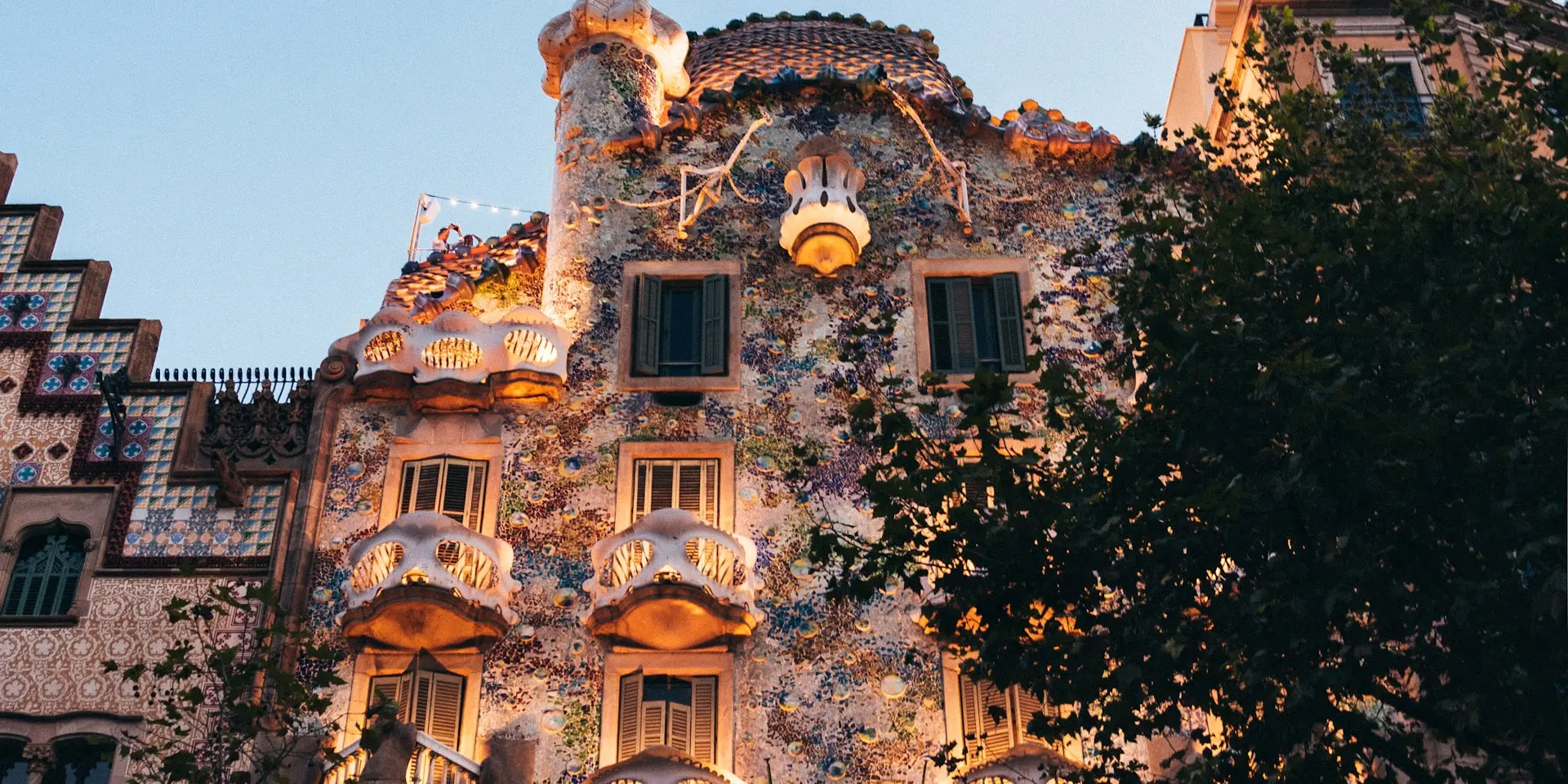
These two Gaudi buildings sit within three blocks of each other on Passeig de Gracia and represent his most mature residential work. Casa Batllo is the more theatrical — a facade of bone-shaped columns and iridescent ceramic tiles that shifts colour in changing light, topped by a roof that resembles a dragon's spine. The interior redesign (completed in recent years with immersive light-and-sound experiences) makes it one of Barcelona's most compelling museum experiences, though it is also one of the most expensive at around 35 euros.
Casa Mila (La Pedrera) is the more structurally radical: a building with no load-bearing walls, an undulating stone facade that earned it the nickname "the quarry," and a rooftop populated by chimney stacks that look like helmeted warriors. The rooftop at sunset is spectacular. Both buildings offer evening or night visits with smaller crowds — worth considering if your daytime schedule is packed.
Beyond Gaudi
Do not leave Barcelona thinking Modernisme begins and ends with one architect. The Palau de la Musica Catalana, designed by Lluis Domenech i Montaner, is an explosion of stained glass, mosaic, and sculptural ornament that makes the average concert hall look like a parking garage. Attend a performance if you can — the acoustics match the visuals. The Hospital de Sant Pau, also by Domenech i Montaner, is a complex of 27 Modernista pavilions connected by underground tunnels, set in gardens. It functioned as a working hospital until 2009 and now operates as a museum and cultural centre. It receives a fraction of Sagrada Familia's visitors and deserves far more.
Skip-the-line entry for Sagrada Familia, Casa Batllo, Park Guell, and more — plus guided walking tours and unique experiences across Barcelona.
Browse Barcelona Activities →Food Markets and Where to Eat
Barcelona's relationship with food is not performative. There is no equivalent of the Parisian restaurant scene's occasionally stiff formality. Here, great food happens in places with paper tablecloths and plastic chairs as often as it does in Michelin-starred dining rooms. The markets are where it starts.
La Boqueria
The most famous food market in Europe sits halfway down La Rambla and has been feeding Barcelona since the 13th century in one form or another. It is also the most tourist-photographed, and the stalls near the entrance have adjusted their prices and products accordingly. The strategy is simple: walk past the first three rows. The stalls deeper inside and along the back wall cater to locals who shop here daily. Look for seasonal fruit (the stone fruits in summer are extraordinary), fresh seafood, and the prepared food counters where you can sit at a bar stool and eat a plate of grilled prawns or a bocadillo de jamon for a third of what a nearby restaurant charges.
Go before 10am to see the market as a functioning wholesale operation rather than a tourist attraction. By noon the aisles are shoulder-to-shoulder and the experience changes entirely.

Mercat de Sant Antoni
This is the market the locals prefer, and after a major renovation that restored its original 1882 iron-and-glass structure, it has become one of the most beautiful market buildings in Spain. The food hall downstairs has everything La Boqueria offers without the crowd density. On Sundays, a book and vintage market wraps around the exterior — a Barcelona tradition dating back decades. The surrounding Sant Antoni neighbourhood has become one of the city's best eating districts, with a concentration of natural wine bars and modern Catalan restaurants along Carrer del Parlament.
Mercat de Santa Caterina
Smaller and quieter than the other two, Santa Caterina sits in the El Born neighbourhood beneath a spectacular undulating mosaic roof designed by Enric Miralles. The food stalls are excellent and the attached restaurant, Cuines Santa Caterina, serves market-fresh dishes in a setting that feels nothing like a tourist trap. It is also the market closest to the Gothic Quarter, making it an easy midday stop during a walking tour of the old city.
Where to Eat: Specific Recommendations
- Cal Pep (El Born) — A tapas counter that has been serving since 1989. There is no menu in the traditional sense; Pep and his team serve whatever is best from the market that morning. The fried artichokes, the clams, and the tortilla are legendary. Arrive before the 7:30pm opening or expect a wait. No reservations for the bar — only for the back dining room, which lacks the atmosphere.
- Bar Canete (Raval, near La Rambla) — A long marble bar serving refined Catalan tapas. The croquetas are among the best in the city, the grilled razor clams are perfect, and the wine list is deep without being pretentious. Slightly pricier than the average tapas bar but worth every euro.
- La Pepita (Gracia) — A neighbourhood favourite in Gracia known for creative open-faced sandwiches and a relaxed, young atmosphere. The walls are covered in handwritten notes from customers. Try the bikini trufa (truffle-infused ham and cheese toastie) and the patatas bravas with aioli.
- Cerveceria Catalana (Eixample) — Often cited as the best all-round tapas bar in Barcelona for visitors. The display case of pintxos at the bar is enormous and everything is good. Popular with both tourists and locals, which says something. Go for lunch to avoid the worst dinner queues.
Dishes You Must Try
Patatas bravas — Fried potato cubes with spicy tomato sauce (salsa brava) and sometimes aioli. Every bar has its own version and arguing about who makes the best is a local sport. Pa amb tomaquet — Bread rubbed with ripe tomato, drizzled with olive oil, and sprinkled with salt. Sounds absurdly simple. Tastes transcendent when the tomatoes and oil are right. Served with nearly everything. Bombas — Potato croquettes stuffed with spiced meat, fried, and served with aioli and brava sauce. A Barcelona original from Barceloneta. Escalivada — Roasted red pepper, aubergine, and onion, peeled and dressed with olive oil. Served cold or at room temperature. The Catalan vegetable dish that converts people who think they do not like aubergine.
Taste your way through La Boqueria, the Gothic Quarter tapas bars, and hidden local favourites with a knowledgeable guide. One of the best ways to experience Barcelona's food scene.
Browse Food Tours →The Gothic Quarter and El Born
The oldest part of Barcelona is a labyrinth. Streets narrow to the width of a handshake. Medieval stone walls rise four and five storeys, blocking the sun and creating a permanent twilight at ground level. Laundry hangs between buildings. A Roman aqueduct pillar stands in the middle of a square. A 14th-century church hides behind a row of vintage shops. Getting lost here is not a risk — it is the entire point.
A Walking Route Through the Gothic Quarter
Start at Placa de Catalunya, the large central square that marks the boundary between the old and new city. Walk south down Portal de l'Angel (a pedestrianised shopping street) and turn right into the narrow lanes that lead to the Barcelona Cathedral — not to be confused with Sagrada Familia, which is not technically the city's cathedral. The Cathedral of the Holy Cross and Saint Eulalia is a Gothic structure dating to the 13th century with a cloister containing thirteen white geese (one for each year of the martyred Saint Eulalia's life).
From the Cathedral, wind south through the lanes to Placa Reial, a grand arcaded square with palm trees, Gaudi-designed lampposts (his first public commission), and a concentration of restaurants and bars. It is beautiful, lively, and slightly touristy — embrace it for one drink and move on. Head east through Carrer d'Avino toward the Pont del Bisbe, the neo-Gothic bridge connecting two buildings across Carrer del Bisbe. It is one of the most photographed spots in the old city and genuinely atmospheric, especially at night when the streetlights catch the stone carvings.

El Born
Cross Via Laietana (the boulevard that divides the Gothic Quarter from El Born) and the character shifts. El Born was Barcelona's medieval merchant district and has reinvented itself as the city's most stylish neighbourhood for boutique shopping, cocktail bars, and cultural spaces. The Picasso Museum occupies five connected medieval palaces on Carrer de Montcada and houses the most comprehensive collection of Picasso's early work, including the entire Las Meninas series. Book online to skip the queue.
The Basilica de Santa Maria del Mar is El Born's architectural centrepiece — a 14th-century Catalan Gothic church built in a record 54 years (most Gothic cathedrals took centuries). The interior is remarkable for its proportions: slender octagonal columns rise to a vaulted ceiling that creates a sense of vast, airy space unlike any other church in Spain. If you are interested in the history, Ildefonso Falcones' novel Cathedral of the Sea is set during its construction and sold 10 million copies. Entrance is free.
The streets around Santa Maria del Mar — Carrer del Rec, Carrer de l'Argenteria, Passeig del Born — are El Born's social spine. Independent clothing shops, design stores, wine bars, and cocktail lounges stack up along these blocks. The Passeig del Born itself is a wide tree-lined boulevard that becomes an open-air social gathering point on warm evenings.
Beaches: The Ones Worth Your Time
Barcelona is unusual among major European cities in having genuinely usable urban beaches. The waterfront was completely rebuilt for the 1992 Olympics, transforming an industrial port into several kilometres of sandy coastline. Not all of it is worth your afternoon, though. Here is the breakdown.
- Barceloneta Beach — The closest beach to the city centre and the most crowded. The sand is wide, the water is clean (genuinely — Barcelona's beach water quality has improved enormously), and the atmosphere is energetic. It is lined with chiringuitos (beach bars) serving cold beer and paella. Go on a weekday if you want to actually lay down a towel without negotiating with your neighbours. The Barceloneta neighbourhood itself — the old fishermen's quarter — is worth walking through for its narrow streets and seafood restaurants.
- Bogatell Beach — Two beaches north of Barceloneta and significantly calmer. Popular with locals, joggers, and swimmers rather than tourist groups. The water quality is consistently high and the vibe is relaxed without being deserted. This is where Barcelona residents actually go to the beach.
- Nova Icaria Beach — Between Barceloneta and Bogatell, flanked by the Olympic Port. Good facilities (showers, volleyball nets), family-friendly, and well-maintained. The nearby Olympic Port has a cluster of restaurants — most are mediocre tourist traps, but the waterfront setting is pleasant for a drink.
- Mar Bella Beach — Further north, quieter still, with a section that has traditionally been Barcelona's nudist beach (though enforcement is relaxed and clothing-optional is a better description). Popular with a younger crowd. Has a good chiringuito and a skate park adjacent.
The Hidden Option: Ocata Beach
Take the Rodalies commuter train (R1 line) north from Passeig de Gracia or Placa de Catalunya to El Masnou station — about 25 minutes. Walk five minutes east to Ocata beach, a long, wide stretch of golden sand that feels like a different world from Barceloneta. The water is clearer, the sand is cleaner, and on a weekday you can find twenty-metre stretches of empty beach. There is a beach bar, a few restaurants along the promenade, and nothing else. Bring a book and a towel. This is one of the best day-trip beaches accessible from any major European city.
When to Visit
Spring (April to May) is the consensus best time. Temperatures sit between 17 and 23 degrees Celsius, the city is green after winter rains, outdoor terraces reopen, and the tourist volume has not yet peaked. Prices for accommodation are 20-30% lower than July and August. The beach is usable from late April for the hardy but most visitors wait until May. Cultural programming ramps up: Sant Jordi's Day on April 23 fills the streets with book stalls and rose vendors in one of Barcelona's most charming traditions.
Summer (June to August) is hot — mid-30s Celsius regularly, occasionally pushing past 38. The city is at maximum tourist capacity. La Rambla becomes an obstacle course. Accommodation prices peak. That said, the beach is at its best, the outdoor festivals are constant, and the long evening light means you can sit at a terrace at 9pm in full sunshine. If you go in summer, front-load your indoor cultural visits (museums, Sagrada Familia, markets) in the morning and save beaches and outdoor dining for late afternoon onward.
Autumn (September to October) is the smart traveller's window. September weather is essentially summer without the August crush. The sea is at its warmest after months of summer sun. October brings slightly lower temperatures (18-24 degrees), thinner crowds, and reduced prices. La Merce, Barcelona's biggest street festival, takes place in the last week of September — four days of free concerts, human tower competitions (castellers), fire runs (correfoc), and parades. It is genuinely spectacular and largely attended by locals rather than tourists.
Winter (November to March) is mild by northern European standards — daytime temperatures rarely drop below 10 degrees and sunny days are common. Some outdoor attractions reduce hours, the beach is off the agenda for most visitors, and a handful of restaurants close for January holidays. But hotel prices drop 40-50%, the major museums and architectural sites are crowd-free, and the city's restaurant and bar culture operates year-round. Christmas markets appear in December (the one at the Cathedral is the most traditional), and the city celebrates the Feast of the Three Kings on January 5-6 with a major parade.
Neighbourhoods Beyond the Tourist Core
The biggest mistake first-time visitors make in Barcelona is never leaving the rectangle between La Rambla, Sagrada Familia, and the beach. The city's most interesting daily life happens in the neighbourhoods that surround this tourist core.
Gracia
Originally an independent village that was absorbed into Barcelona in 1897, Gracia retains a distinct identity: quieter, more bohemian, more Catalan-speaking. The streets are narrower, the buildings lower, and the plazas are genuine neighbourhood gathering points rather than tourist stages. Placa del Sol is the social centre — ringed by bars and cafes, it fills with locals every evening. The surrounding streets are packed with independent shops, vintage stores, and some of the city's best casual restaurants. In August, the Festa Major de Gracia transforms the neighbourhood for a week as residents spend months decorating their streets with elaborate themes — entire blocks become immersive art installations. It is one of Barcelona's most joyful events.
Poble Sec
Wedged between Montjuic hill and the Parallel avenue, Poble Sec has quietly become one of Barcelona's best eating neighbourhoods. The focal point is Carrer de Blai, a pedestrianised street lined with pintxos bars — Basque-style small bites served on bread, priced at 1-2 euros each and displayed on the bar top. The tradition is to bar-hop, eating two or three pintxos at each stop, and the street has enough variety (seafood, Iberian ham, vegetarian, creative fusion) to sustain an entire evening. Start at Blai 9 or La Tasqueta de Blai for the classics. The neighbourhood also has excellent wine bars — Bodega Salvat and Cellar de Gelida are both worth seeking out.
Poblenou
Barcelona's former industrial district — once called the "Manchester of Catalonia" for its concentration of textile factories — has reinvented itself as the city's creative and tech quarter. Old factory buildings now house design studios, coworking spaces, galleries, and breweries. The Rambla del Poblenou is a quieter, tree-lined boulevard that feels nothing like its more famous namesake. The neighbourhood's proximity to the quieter northern beaches (Bogatell, Mar Bella) makes it an excellent base for visitors who want beach access without the Barceloneta chaos. The restaurant scene is growing fast: Els Pescadors in Placa Prim is a long-standing seafood institution, and the tapas bars along Carrer de Pere IV are increasingly excellent.
Sant Antoni
Centred around the renovated Mercat de Sant Antoni, this neighbourhood has seen the most dramatic transformation in Barcelona over the past decade. Carrer del Parlament has become a destination street for restaurants and bars — Federal for brunch, Flauta for modern Catalan cooking, and a growing number of natural wine bars. The area has a young, creative energy and remains predominantly local despite its rising profile. The Sunday book market around the Mercat building is a Barcelona tradition worth experiencing.
Photo Spots — Three Unmissable Frames
-
1Bunkers del CarmelA former anti-aircraft battery from the Spanish Civil War, perched on a hilltop in the Carmel neighbourhood with a full 360-degree panoramic view of Barcelona. The city unfolds beneath you — the grid of the Eixample, the towers of Sagrada Familia, Montjuic, the port, and the Mediterranean stretching to the horizon. At sunset the entire scene turns gold and the scattered groups of locals watching from the concrete platforms create a communal atmosphere that feels entirely un-touristy. Free entry, no tickets required.Best time: 1 hour before sunset. Bring a drink and a blanket. Walk up from Alfons X metro (20 min uphill) or take bus 119.
-
2Sagrada Familia Interior — Morning Stained GlassThe exterior of Sagrada Familia is what draws you in, but the interior is what takes your breath away. In the morning, sunlight pours through the east-facing stained glass windows and scatters across the white stone columns and floor in pools of red, orange, and gold. As the sun moves, the colours shift — by midday, the west windows contribute blues and greens. The effect is unlike any other church interior in the world: Gaudi designed the windows specifically to create this chromatic progression throughout the day. Photographers should stand in the central nave and shoot upward along the tree-shaped columns to capture the light filtering through the canopy.Best time: 9:00–10:30am for warm eastern light. Book the earliest available ticket slot for the smallest crowds.
-
3Pont del Bisbe, Gothic QuarterThis ornate neo-Gothic bridge spans Carrer del Bisbe, connecting the Palau de la Generalitat (seat of the Catalan government) to the Casa dels Canonges. Built in 1928 by Joan Rubio i Bellver, a former assistant of Gaudi, the bridge features delicate stone tracery, gargoyles, and a skull with a dagger embedded in it (supposedly a curse or a blessing depending on which local legend you prefer). The narrow medieval street below frames the bridge perfectly, and in the evening, the warm lamplight against the dark stone creates a dramatically moody composition. Arrive early morning or late evening to photograph it without crowds filling the lane.Best time: Early morning for clean shots, or after 9pm for atmospheric lamplight. Weekday evenings are quietest.
Budget Quick Facts
- Accommodation: Hostels from 25-40 euros/night. Mid-range hotels 100-170 euros/night. Boutique/luxury 200-400+ euros/night. Airbnb apartments 80-150 euros/night (tourist licence required — check the listing).
- Meals: Coffee and pastry 3-5 euros. Market lunch or bocadillo 6-10 euros. Tapas dinner (per person, with drinks) 25-40 euros. Restaurant dinner 35-60 euros. Fine dining 80-150+ euros.
- Transit: T-casual 10-trip card: 11.35 euros (valid on metro, bus, tram, and Rodalies commuter trains within Zone 1). Single metro ticket: 2.55 euros. Airport metro: 5.50 euros. Taxis from airport to city centre: 39 euros (flat rate).
- Museum passes: Sagrada Familia 26-36 euros (with tower access). Casa Batllo 35 euros. Park Guell 10 euros. Picasso Museum 12 euros (free first Sunday of the month). Articket BCN (6 museums) 38 euros — excellent value.
- Tipping: Not expected but appreciated. Rounding up the bill or leaving 5-10% at restaurants is generous by local standards. No tipping at bars or cafes.
Everything you need to lock in your Barcelona trip — compare hotel prices, book skip-the-line tickets, and find train routes across Spain and Europe.
Ready to plan your Barcelona trip?
Tell Tripva your travel dates, interests, and pace — and we'll build a personalised day-by-day Barcelona itinerary with restaurant picks, neighbourhood walks, and timing notes. Takes 30 seconds.
Plan Your Barcelona Trip ✦