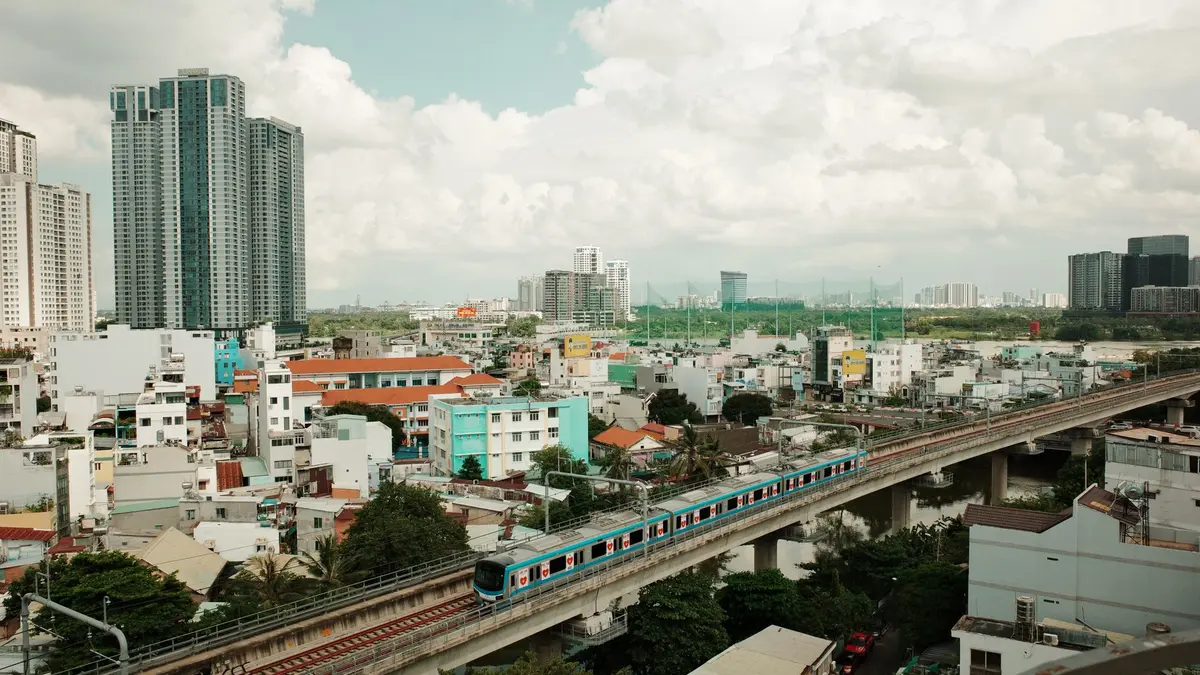
Vietnam is 1,650 kilometres long and roughly 50 kilometres wide at its narrowest. The country is shaped like a bamboo pole with a rice basket at each end, and the Reunification Express runs the length of that pole — from Hanoi in the north to Ho Chi Minh City in the south, tracing the coast through rice paddies, limestone karsts, fishing villages, and some of the most spectacular mountain scenery in Southeast Asia.
You could fly between the two cities in two hours. Most travellers do. But the train does something flying cannot: it shows you the country between the airports. The 30-to-34-hour journey from Hanoi to HCMC is not a way to get somewhere — it is the somewhere. And unlike most long-distance trains in Southeast Asia, the Reunification Express is genuinely comfortable, surprisingly affordable, and one of the great railway journeys on earth.
This guide covers everything you need to ride the line in 2026: how to book, which class to choose, where to break the journey, what to eat on board, and which segment produces the single best view you will see from any train window in Asia.
What Is the Reunification Express?
The Reunification Express is the informal name for the SE (Special Express) trains that run the full 1,726-kilometre north-south line between Hanoi and Ho Chi Minh City. The railway itself is the only main line in Vietnam, a single-track, metre-gauge route originally built by the French colonial administration between 1899 and 1936. It was destroyed during the American War, rebuilt after reunification in 1976, and has been continuously operating since.
The name "Reunification Express" is a traveller's invention — the Vietnamese call it the duong sat Thong Nhat (Unification Railway). Vietnam Railways (Duong Sat Viet Nam, DSVN) operates the line with several daily departures in each direction. The fastest SE trains (SE1/SE2, SE3/SE4) cover the full distance in approximately 30-34 hours. Slower local trains stop at every station and take considerably longer.
- Total distance: 1,726 km (Hanoi to Ho Chi Minh City)
- Travel time (express): 30-34 hours end-to-end
- Key stops: Hanoi, Ninh Binh, Vinh, Dong Hoi, Hue, Da Nang, Tam Ky, Quang Ngai, Dieu Tri (Quy Nhon), Nha Trang, Phan Thiet, Ho Chi Minh City
- Daily departures: 5-6 trains each direction
- Operator: Vietnam Railways (DSVN)
- Gauge: 1,000 mm (metre gauge)
Most travellers do not ride the full 30+ hours in one go. The smarter approach — and the one this guide recommends — is to break the journey into segments, spending a day or two in each stop city. This turns a long train ride into a two-week itinerary that covers central Vietnam's highlights without a single flight.
The Route: Segment by Segment
The Reunification Express runs through four natural segments, each with its own character. Here is the route as most travellers ride it, south to north or north to south.
12Go is the easiest way to book Vietnam Railways tickets in English. Search routes, compare classes, and get e-tickets delivered to your inbox.

Ticket Classes Explained
Vietnam Railways operates four ticket classes on the Reunification Express. The differences are significant, and your choice will define your experience on the train. Prices below are for the full Hanoi-to-HCMC journey in 2026; shorter segments are proportionally cheaper.
Hard Seat (Ghe Cung)
Upright wooden or lightly padded seats, three abreast on each side. This is what Vietnamese commuters use for short hops. For the full 30+ hour journey, hard seat is genuinely punishing. The seats do not recline. The carriages are crowded, noisy, and there is no personal space. This class exists for budget travellers who want a war story, not comfort.
Price (Hanoi → HCMC): 600,000-750,000 VND (~$24-30 USD)
Soft Seat (Ghe Mem)
Padded reclining seats, two abreast on each side, similar to a regional airline's economy class. Air-conditioned. Manageable for the shorter segments (Hue to Da Nang, Nha Trang to HCMC) but still uncomfortable for overnight journeys. A reasonable choice if you are doing a daytime leg under 4 hours.
Price (Hanoi → HCMC): 800,000-1,000,000 VND (~$32-40 USD)
Hard Sleeper (Giuong Nang) — 6-Berth Compartment
Six berths stacked three-high in a small compartment — two columns of three bunks facing each other. Each berth gets a thin mattress, pillow, sheet, and blanket. The bottom bunks double as seats during the day. The top bunk is the cheapest and the most private, but claustrophobic for larger travellers. The middle bunk is the sweet spot: enough headroom, reasonable privacy, and a view out the corridor window. Air-conditioned.
Price (Hanoi → HCMC): 950,000-1,200,000 VND (~$38-48 USD) depending on berth position
Soft Sleeper (Giuong Mem) — 4-Berth Compartment
Four berths in a private compartment with a sliding door — two upper, two lower. Wider bunks, thicker mattresses, cleaner linens. The compartment has its own reading lights, a small fold-down table, and space for luggage under the bottom bunks. This is the class most international travellers choose, and for good reason. It is comfortable enough for overnight journeys, private enough for couples or solo travellers, and still remarkably cheap by global standards.
Price (Hanoi → HCMC): 1,200,000-1,600,000 VND (~$48-64 USD) depending on berth position
| Class | Configuration | Hanoi → HCMC | Hanoi → Hue | Hue → Da Nang |
|---|---|---|---|---|
| Hard Seat | Upright, no recline | ~$24-30 | ~$14-18 | ~$4-6 |
| Soft Seat | Padded, reclines | ~$32-40 | ~$18-24 | ~$5-8 |
| Hard Sleeper (6-berth) | 3-high bunks, shared | ~$38-48 | ~$22-28 | ~$6-9 |
| Soft Sleeper (4-berth) | 2-high bunks, private door | ~$48-64 | ~$28-36 | ~$8-12 |
- Overnight journeys (6+ hours): Soft sleeper. Always. The price difference over hard sleeper is $10-15 and the comfort difference is enormous.
- Daytime journeys under 4 hours: Soft seat is fine. The Hue-to-Da Nang scenic leg is best done in soft seat — you want to sit up and watch the view, not lie in a bunk.
- Daytime journeys 4-10 hours: Hard sleeper bottom bunk — use it as a seat during the day, lie down when you want a nap. Best value for mid-length legs.
- Budget absolute minimum: Hard sleeper top bunk. Cheapest bed on the train and perfectly adequate if you are not very tall.
How to Book Tickets
There are three ways to book tickets on the Reunification Express. Each has trade-offs.
1. Vietnam Railways Official Website (dsvn.vn)
The official booking site accepts international credit cards and issues e-tickets. The interface has improved significantly since 2024 — it now has an English-language option and a reasonably functional seat map. Book here for the cheapest possible price with no markup. Tickets open 60 days before departure. The site can be slow during peak booking periods (pre-Tet, September-November high season), and customer support is in Vietnamese only.
2. 12Go Asia (recommended for most travellers)
12Go is a third-party booking platform that aggregates Vietnam Railways schedules and adds English-language support, real-time availability, and e-ticket delivery. The markup over the official price is typically 10-15%, which buys you a reliable English interface, proper email confirmations, and a customer service team that actually responds. For most international travellers, the convenience is worth the small premium.
12Go also lets you compare train versus bus versus flight for each route on a single page — useful for deciding whether the Da Nang to Hoi An bus makes more sense than a train-plus-taxi combination.
3. Station Counters (walk-up)
Every station has a ticket counter. This works well if you are flexible on dates and classes, speak some Vietnamese (or bring Google Translate), and do not mind the risk of sold-out soft sleeper berths during peak season. Walk-up booking is the cheapest option — no markup, no booking fee — but popular berths on popular trains sell out days in advance during September-November and around Tet. For the Hue-to-Da Nang scenic leg, walk-up is usually fine because the journey is short and there are multiple daily departures.
Compare trains, buses, and ferries across Vietnam. Book in English with e-ticket delivery and free cancellation on most routes.
Search Hanoi → HCMC Routes →Best Segments for Scenery
Not all 1,726 kilometres are equally scenic. The north and south extremes of the route — the flat Red River Delta around Hanoi and the Mekong lowlands approaching HCMC — are agricultural plains. Beautiful in their own flat, green, paddy-field way, but not what makes this railway famous.
The central section, roughly from Dong Hoi to Nha Trang, is where the landscape becomes extraordinary. Within that stretch, one segment stands above the rest.
Hue to Da Nang: The Hai Van Pass (2.5-3 hours)
This is the single greatest train journey in Southeast Asia. Full stop.
The railway climbs from sea level at Hue to the Hai Van Pass (496 metres) and descends steeply to the coast at Da Nang. The track was carved into the mountainside by French engineers in the 1900s, and it clings to the cliffs above Lang Co Bay with sheer drops to the turquoise water below. At the summit, you can see both Hue's lagoon to the north and Da Nang's bay to the south on clear days. The descent into Da Nang is equally dramatic — the train spirals down through tunnels and emerges onto bridges spanning deep ravines.
The road over Hai Van Pass was famously featured on Top Gear as "one of the best coast roads in the world." The railway takes an even more dramatic line, higher on the mountain, with views the road cannot match.
- Sit on the left side (heading south, Hue to Da Nang) for the best ocean views and Lang Co Bay panorama
- Book soft seat, not sleeper for this leg — you want to be sitting upright at the window
- Best light: Morning trains (depart Hue 6-9am) get the best conditions. Afternoon trains face into the sun.
- The pass crossing takes about 40 minutes — the rest of the 2.5-hour journey is flat coastal running
- Have your camera ready as you exit the longest tunnel — the view of Da Nang Bay appears suddenly and is gone in seconds
Dong Hoi to Hue (3-4 hours)
The stretch south of Dong Hoi runs through increasingly dramatic karst landscape as the train approaches the DMZ and the narrow waist of Vietnam. The Phong Nha-Ke Bang national park is visible to the west. This section is best in early morning light.
Da Nang to Quy Nhon (5-6 hours)
The coastal running south of Da Nang is beautiful in a quieter way — fishing boats on empty beaches, coconut palms, and small-town Vietnam rolling past at a pace that encourages staring out the window rather than reaching for your phone. Sit on the left side heading south for the ocean views.

Three Best Photo Spots from the Train
-
1Lang Co Bay from Hai Van PassAs the train climbs northward out of Da Nang (or descends southward toward it), the lagoon of Lang Co appears below — a crescent of turquoise water separated from the sea by a narrow sand spit. The contrast between the deep blue ocean, the pale lagoon, and the green mountains is stunning. Best shot from the left side heading south, about 20 minutes after departing Hue.Tip: Use burst mode — the trees break your window view every few seconds. You need 10 shots to get 1 clean frame.
-
2The Bridge at Ninh Binh (Tam Coc Karsts)About 2 hours south of Hanoi, the train crosses a long bridge over the Day River with limestone karsts rising from flooded rice paddies on both sides. It looks like Ha Long Bay on land — because geologically, it is. The view lasts about 3-4 minutes. Right side of the train heading south.Tip: Set your alarm if you are on the overnight train southbound — this view happens around 9:30pm in darkness. Take the daytime SE7 instead for this shot.
-
3The Fishing Beach North of Quy NhonBetween Tam Ky and Dieu Tri station (the stop for Quy Nhon), the train runs directly along the beach for several kilometres. At dawn or late afternoon, you will see hundreds of round basket boats (thung chai) beached on the sand with fishermen sorting the morning catch. It is the most Vietnamese scene on the entire route.Tip: The beach sections appear intermittently over about 45 minutes. Stay at the window — the best moments are unpredictable.
Food on the Train
You will not go hungry on the Reunification Express. There are three food sources on board, and the quality is better than you might expect.
The restaurant car
Most SE trains have a basic restaurant car serving rice dishes, pho, and banh mi. Prices are slightly above street level — expect 40,000-70,000 VND ($1.60-2.80) for a rice plate with meat and vegetables. The pho is usually decent. The coffee is Vietnamese-style (strong, with condensed milk) and costs about 15,000 VND ($0.60). The restaurant car is also the most social space on the train — it is where you will meet other travellers and where the Vietnamese passengers go to drink beer and play cards in the evening.
Roving vendors
Vendors walk through the carriages every 30-60 minutes selling snacks: banh mi, fruit, dried squid, instant noodles (the staff will give you hot water), beer, soft drinks, and bottled water. The banh mi from train vendors is surprisingly good — fresh baguette, pate, pickled vegetables, chilli sauce — and costs 20,000-30,000 VND ($0.80-1.20). This is the same banh mi you would pay $0.80 for on the street. Buy two.
Platform stops
At major stations (Hue, Da Nang, Nha Trang), the train stops for 10-20 minutes. Vendors crowd the platform selling local specialties. Hue is famous for banh bot loc (translucent tapioca dumplings with shrimp and pork), Nha Trang for fresh fruit and nem nuong (grilled pork sausage). These platform stops are the best food moments of the journey. Bring small bills — vendors expect exact change.
- Water: 2-3 litres for overnight journeys. You can buy more on the train but it costs 2x street price.
- Snacks: Buy fruit, bread, and banh mi before boarding at the station area. Hanoi station has a convenience store.
- Cup noodles: Hot water is free from the train staff. This is the standard Vietnamese train meal for a reason.
- Beer: Available on board but cheaper from a convenience store before departure. Bia Saigon or Bia Ha Noi, 10,000-15,000 VND ($0.40-0.60) at the station, 20,000-25,000 VND on the train.
Accommodation Near Stations
If you are breaking the journey into segments (which you should), here is where to stay near each station. All prices are for a standard double room in mid-range accommodation.
Hanoi
Hanoi station (Ga Ha Noi) is on Le Duan street, about 1.5 km southwest of the Old Quarter. The area around the station itself is not the best neighbourhood for tourists — stay in the Old Quarter (Hoan Kiem district) and take a 15-minute Grab to the station. Budget: 400,000-800,000 VND ($16-32) for a clean guesthouse or hotel in the Old Quarter. Mid-range: 1,000,000-2,000,000 VND ($40-80) for a boutique hotel.
Hue
Hue station is well located — a 10-minute walk to the Citadel and the south bank of the Perfume River. The area between the station and the river has dozens of guesthouses and small hotels. Budget: 300,000-600,000 VND ($12-24). Mid-range: 800,000-1,500,000 VND ($32-60). Hue is one of the cheapest cities in Vietnam for accommodation.
Da Nang
Da Nang station is in the city centre, about 2 km from the beach. If you want beachfront, stay on My Khe Beach (Da Nang Beach) — a 10-minute Grab ride. If you are day-tripping to Hoi An, stay near the station and catch the bus. Budget: 400,000-700,000 VND ($16-28). Mid-range: 900,000-1,800,000 VND ($36-72).
Hoi An
Hoi An has no train station — the nearest is Da Nang (30 km). A local bus runs every 20 minutes for 30,000 VND ($1.20), or a Grab costs about 200,000 VND ($8). Stay in Hoi An's old town for at least two nights — it is the most atmospheric town in central Vietnam. Budget: 350,000-700,000 VND ($14-28). Mid-range: 800,000-2,000,000 VND ($32-80).
Nha Trang
Nha Trang station is 2 km from the beach, an easy walk or 5-minute Grab. The main tourist strip along Tran Phu beach road has everything from $10 dorm beds to $150 resorts. Budget: 300,000-600,000 VND ($12-24). Mid-range: 800,000-1,500,000 VND ($32-60).
Compare Nha Trang hotel prices
Ho Chi Minh City
Saigon station (Ga Sai Gon) is in District 3, about 2 km north of District 1 (the backpacker and tourist centre). A Grab to Bui Vien or Ben Thanh market takes 10-15 minutes. Stay in District 1 for nightlife and restaurants, or District 3 for more local atmosphere and lower prices. Budget: 400,000-800,000 VND ($16-32). Mid-range: 1,000,000-2,500,000 VND ($40-100).
Compare prices from hundreds of hotels in every stop city on the Reunification Express line.
Sleeper Bus vs. Train
Vietnam's sleeper buses are the main alternative to the train for budget long-distance travel. They deserve an honest comparison because for some legs, the bus is genuinely better.
When the bus wins
- Nha Trang to HCMC (7-8 hours): Sleeper buses run frequently, are slightly faster than the train, and cost about the same (250,000-350,000 VND / $10-14). The scenery on this leg is flat and uninteresting — you will not miss anything by taking the bus.
- Da Nang to Hoi An (1 hour): There is no train to Hoi An. Bus or Grab are your only options.
- Late-night departures: Buses run 24 hours on popular routes. If you miss the last train, a sleeper bus at midnight is a reasonable backup.
When the train wins
- Hue to Da Nang: The Hai Van Pass by train is incomparably better than the highway tunnel the bus takes. This is the one leg where the train is not just better — it is the entire point.
- Any journey over 8 hours: A train berth is a real bed. A sleeper bus berth is a reclining pod. For overnight travel, the train's hard sleeper is more comfortable than any bus.
- Safety: Vietnam's road safety record is poor. The train is statistically far safer than a bus, particularly at night.
- Romance: Nobody has ever written a travel essay about a Vietnamese sleeper bus. The Reunification Express has inspired thousands.
For a complete comparison of trains, buses, and flights between Hanoi and HCMC, 12Go shows all options on a single page with real-time prices.
When to Go: Season Guide
Vietnam stretches across three climate zones, and the Reunification Express crosses all of them. There is no single "best time" for the whole route, but some months are significantly better than others.
September to November is the sweet spot. The north has cooled from summer heat, the central coast is between typhoon peaks, and the south is finishing its wet season. Trains are less crowded than peak season, and hotel prices are at their lowest. The Hai Van Pass gets its clearest skies in October-November.
February to April is the second-best window. Post-Tet prices drop quickly, the weather is mild across all three zones, and you avoid the summer heat that makes un-air-conditioned station platforms miserable.
May to August is hot everywhere. Temperatures in HCMC and Da Nang exceed 35°C daily. The south gets heavy afternoon rain (predictable — usually 2-4pm, then it clears). The central coast has typhoon risk in September-October. Trains are well air-conditioned, but station transfers and city exploration in the heat are draining.
Avoid Tet (Vietnamese New Year, usually late January or early February). Every train is sold out weeks in advance. Prices for the remaining seats spike 50-100%. Hotels triple their rates. Half of Vietnam is travelling to their home provinces, and the transport system operates at absolute capacity. If you must travel during Tet, book everything at least 60 days ahead.
Practical Tips
Luggage
There is no luggage limit on Vietnamese trains, but practical storage is limited. Soft sleeper compartments have space under the bottom bunks and a small overhead shelf. Hard sleeper carriages have open shelving at the end of each bay. A backpack or soft-sided bag under 20 kg is ideal. Hard-shell suitcases larger than carry-on size are awkward to store. Keep valuables with you — petty theft from luggage in hard seat and hard sleeper carriages is uncommon but not unheard of.
Booking in advance
For soft sleeper berths during peak season (September-November, Tet), book 2-4 weeks ahead. For hard sleeper and soft seat during the same period, 1-2 weeks is usually sufficient. Off-peak, you can often book 2-3 days ahead or even walk up and buy at the station. The Hue-to-Da Nang leg rarely sells out because it is short and has multiple daily departures. The overnight Hanoi-to-Hue leg sells out fastest — book that one first.
Power and connectivity
Newer carriages (especially on SE1-SE4 trains) have power outlets between berths in sleeper compartments. Older carriages may not. Bring a portable battery. Mobile data works for most of the route — Vietnam's 4G coverage is excellent even along the coast — but drops out in the tunnel sections around Hai Van Pass.
Toilets
Each carriage has a squat toilet at one end and a Western-style toilet at the other. Bring your own toilet paper — it is sometimes provided, sometimes not. The toilets are functional but not luxurious. They are cleaned at major station stops but can deteriorate on long overnight journeys. This is the one area where the Reunification Express has not modernised.
Safety
The Reunification Express is safe. Violent crime on trains is essentially nonexistent in Vietnam. The main risk is petty theft of unattended bags, particularly in hard seat carriages. Soft sleeper compartments have a door that locks from the inside — use it at night. Keep your passport, phone, and cash on your person or under your pillow.
The best itinerary structure
Here is the approach that works best for most travellers with 10-14 days:
- Hanoi (2-3 nights): Explore the city. Take the overnight train to Hue (depart ~7:30pm, arrive ~7am).
- Hue (2 nights): Imperial Citadel, royal tombs, street food. Take the morning train to Da Nang (depart ~8am, arrive ~10:30am) for the Hai Van Pass.
- Da Nang / Hoi An (3 nights): Beach, Hoi An old town, My Son ruins. Take the daytime train to Nha Trang (depart ~10am, arrive ~6-8pm).
- Nha Trang (2 nights): Beach, islands, seafood. Take the morning train to HCMC (depart ~7am, arrive ~2pm).
- Ho Chi Minh City (2-3 nights): War Remnants Museum, Cu Chi Tunnels, Saigon food scene.
This structure uses overnight trains for the long first leg, the scenic daytime train for Hai Van Pass, and daytime trains for the remaining segments. Total train time: approximately 30 hours spread over 4 travel days across a 10-14 day trip.
- Book Hanoi → Hue overnight first — this sells out fastest
- Book Hue → Da Nang soft seat for the Hai Van Pass views
- Book Da Nang → Nha Trang hard sleeper bottom bunk for the long coastal leg
- Book Nha Trang → HCMC last — this leg has the most availability
- Book Hanoi and HCMC hotels early; Hue and Nha Trang hotels can be booked closer to arrival

The Reunification Express is not a luxury train. The toilets are basic, the berths are narrow, and the journey is long. But it is honest travel in a way that flying and bussing are not. You see the country change — the paddy fields giving way to karst mountains, the mountains falling into the sea at Hai Van, the fishing villages blurring past as you head south. You eat banh mi from vendors walking the aisle. You drink beer with strangers in the restaurant car while the sun drops below the South China Sea.
Vietnam is one of the most extraordinary countries in Asia, and the train is the way to see it properly. The flight takes two hours and shows you nothing. The Reunification Express takes two days and shows you everything.
Everything you need for the Reunification Express journey — train tickets, hotels along the route, and guided tours.
Ready to plan your Vietnam trip?
Tell Tripva your dates, interests, and budget — we'll build a complete day-by-day itinerary with hotel picks, train bookings, and the perfect Reunification Express schedule.
Plan Your Vietnam Trip ✦Book train tickets at 12Go Asia